“Can ETERNA be Used for Still Photos?” Fujifilm X-H1 Development Story #5
Fujifilm has just published the fifth episode of its Fujifilm X-H1 development Story, and this time it’s again about the new ETERNA film simulation.

But while in part 4 time they described the characteristics of ETERNA, this time they investigate one questions: “Can ETERNA be used for still photos?”

Can it be used for still photos?” We asked the image designing team who created ETERNA mode.

It’s possible. It can work really well in some cases.” […]. We need to take ideology and the characteristics of ETERNA into account for a good result.

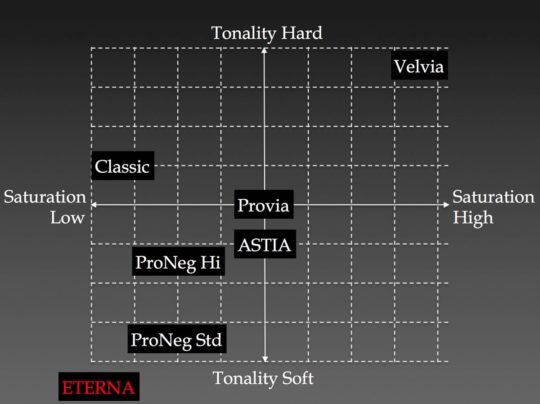
[…] The wide dynamic range and soft tonality will depict the subtle nuances of shadows created in the environment under controlled lights. It will also keep the subject from being oversaturated.

People often use Velvia for landscape photography, but it can be excessive if the subject”s saturation is high. Velvia is good when you need to enhance the saturation, but when the saturation is high enough, try ETERNA or Pro Neg. STD instead.

Another idea is to treat ETERNA in the same way as you would when you shoot cinema, to complement other elements of communication. In editorial, for example, the photographs are combined with texts to deliver a message. ETERNA is a good one to use in editorial as it would complement the text. The images with soft tonality and low saturation allow readers engage into the story seamlessly.

The soft tonality of ETERNA also looks great on matte paper. So when the editorial is printed on a matte paper, then it creates a further enhanced experience for the readers. When you think of the communication in a big picture, ETERNA has its use for sure.

Full story at fujifilm-x

Fujifilm X-H1 – $150 Bundle Savings: BHphoto, AmazonUS, Adorama, Focuscamera
Follow FujiRumors on Facebook, RSS-feed, Instagram, Youtube and Twitter
Fujifilm X-H1 Coverage: X-H1 facebook group + X-H1 facebook Page

Priolite Adds Radio Trigger Support for Fujifilm and Elinchrom “Working on Fujifilm Support”

Priolite Fujifilm Support

On Friday, the European studio strobe lighting company Priolite announced on their instagram here, that it is introducing a version of its RC-HS-F radio trigger for Fujifilm X-Pro2, X-T2 und GFX 50S cameras that will allow syncs at up to 1/8,000 of a second.

Priolite has just a small market share, but there are Fujifilm X shooter using their products, and who lookf forward to Priolite support, such as the FR-reader, who informed me about this news.

Elinchrom

Godox, Profoto, Nissin, Broncolor, Metz, Cactus, Priolite, Jinbei/Orlit, Conomark and more companies have already added Fujifilm support.

Anyone missing?

Oh right, Elinchrom! They don’t seem to be in a hurry to support Fujifilm.

As we reported here, Elinchrom should add Fujifilm support in 2018 according to a press release they made with Rotolight. But so far nothing has happened.

So I did search on their facebook page, and I have found the following Elinchrom statement, made last week: “We are working on it“.

Sooner or later….

FUJIFILM to Showcase New and Innovative Products at WPPI 2018

FUJIFILM TO SHOWCASE NEW AND INNOVATIVE PRODUCTS AT WPPI 2018

Featuring the latest additions to the X Series Line, INSTAX Instant Cameras & Film and Digital Printing Solutions

Valhalla, N.Y., February 23, 2018 – As the leader in photo imaging, FUJIFILM North America Corporation will showcase a comprehensive portfolio of products that offer photographers the highest performance —from capture to print—at the 2018 Wedding and Portrait Photography International Conference & Expo (WPPI) from February 26-28 at Booth #1121 at the Mandalay Bay in Las Vegas, Nevada.

X Series and GFX Mirrorless Camera Systems

** CLICK HERE to Read the Rest of the Article **

Fujifilm X-H1: Palle Schultz Video Footage from Nepal + Shooting ETERNA + Same Sensor as X-T2, but Completely Different Camera

Fujifilm X-H1 in Nepal

Palle Schultz has published Part 2 of his Fujifilm X-H1 videos here on youtube.

While in his first X-H1 video, which we shared in our epic 48+ hours non stop live blogging here, Palle went over all the features in an interesting 20 minutes video, this second part will show you those features in action in Nepal.

Amongst the others, he shows

  • how the autofocus behaves when you set focus speed and tracking independently for natural looking focus (more manual focus-like)
  • lens flare
  • ETERNA
  • 120fps FullHD slow motion upscaled to 4K
  • extreme shadow push
  • AF tracking of a group of funny and adorable kids
  • & more

Shooting Stills with ETERNA

Palle Schultz shows us some great video footage taken with the X-H1’s new ETERNA film simulation. And as also reported earlier today in the ETERNA development story, it is specifically designed for video use, where “time, the movement of performers, and the sounds and voices” have to create a “seamless flow” with the image itself.

So maybe ETERNA will, for most of us, not become our favorite film simulation for stills, but there are situation, where ETERNA can work well also in stills.

In his ETERNA dedicated article, with lot of ETERNA sample images, ivanjoshualoh writes:

I must say initially I didn’t like Eterna. I find it’s a bit flat and the color are not its strongest feature. […] The more I shoot with it, I realize with all things; it has its weaknesses and strength. […] I feel not all pictures works beautifully with Eterna but a good number do. Its does give a beautiful mood to the feel. And I am beginning to see some light at the end of the tunnel.”

& More

Thoughts on the Fuji X-H1 after hands-on with it at Zed ProMedia Youtube. He says:

  • IBIS is really really good
  • Linear focus mode is awesome for video. Wherever you put the lens and bring it back, it is going to be the exact same distance every single time. It will sync up your focus exactly where you want it to be.
  • Fujifilm re-worked the camera. Has the same sensor/processor as X-T2, but it’s a completely different camera
  • More a professional body
  • It’s good that it’s bigger. There are tons of smaller options out there if you want a smaller camera
  • Back-button focussing button feels perfect and is in perfect position. Works great
  • Awesome shutter sound and feel
  • This camera is THE camera for Fujifilm right now

Fujifilm X-H1 – $150 Bundle Savings: BHphoto, AmazonUS, Adorama, Focuscamera
Follow FujiRumors on Facebook, RSS-feed and Twitter
Fujifilm X-H1 Coverage: X-H1 facebook group + X-H1 facebook Page

Fujifilm X-H1 Development Story #4 -Film Simulation ETERNA, or The Art of Omission

Fujifilm X-H1 Development Story #4

Fujifilm has just published the fourth episode of its Fujifilm X-H1 development Story, this time it’s all about the new ETERNA film simulation.

Fujifilm X-H1 – $150 Bundle Savings: BHphoto, AmazonUS, Adorama, Focuscamera

STILLS Vs. FILM:

Let’s examine the difference between photographic and cinematic expression.

In photographic expression, the basic communication is complete in a single frame. For that purpose we put emphasis on color as an important element to deliver the photographer’s message. For example, the blue sky is enhanced so when reflecting back to the memory, it is as clear as it can be. The colors are enhanced to an extent so that the image still looks natural. Other colors are treated the same way. In FUJIFILM, we refer the color reproduction as “Image Color”.

Cinema communicates differently. In cinema, there are the transition of time, the movement of performers, and the sounds and voices. The image designing in cinema should complement all these elements to create a seamless flow. If the cinematic image design were completed in each frame in the same way as the photographic expression with enhanced colors, then the flow would not be so smooth. In Cinema, the saturation is suppressed, so a particular color would not stand out. The tonality is wide to deliver the atmospheric vibe of the scene. This is the characteristic of cinematic image design. People often refer to it as “Cinema Look” or “Film Look”.

[…] The film simulation “ETERNA” is designed to achieve the “Cinema Look” in one take. The dynamic range is 12-stop wide. The highlight and shadow tones are both soft. The difference is obvious when it is compared with PROVIA (with the dynamic rage set at 100%). The dynamic range is comparable to that of F-Log. It has room for post production, so this also comes handy.

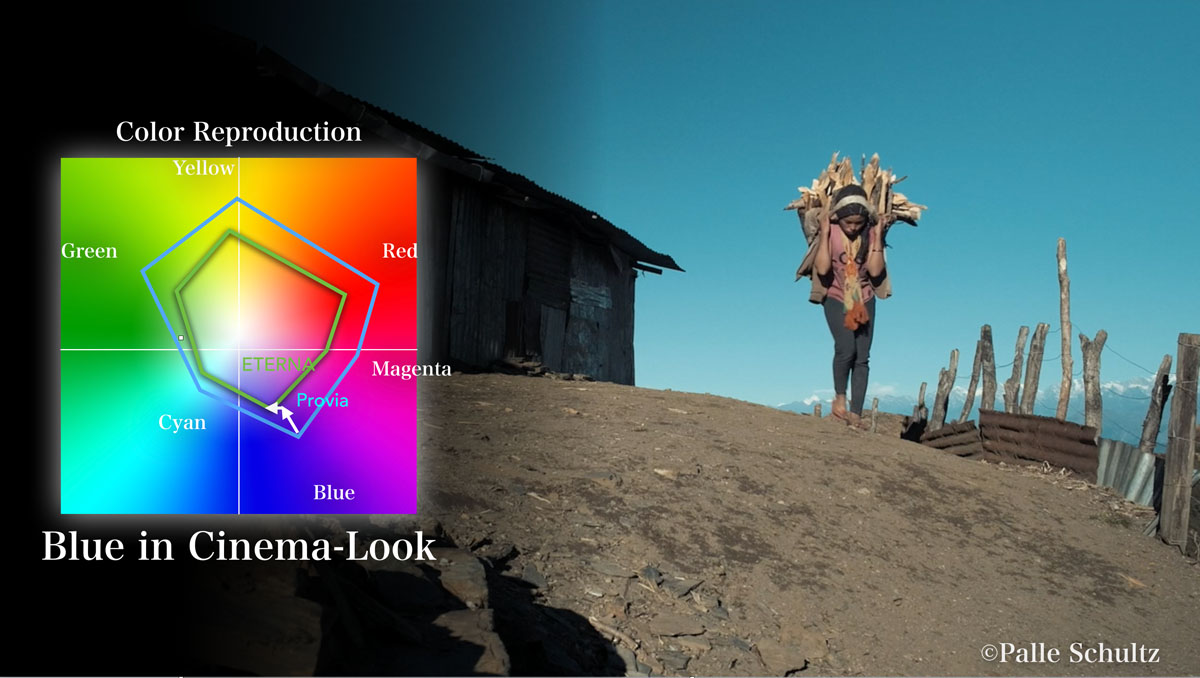
[…] The saturation is suppressed and is slightly adjusted on each key color. A touch of magenta was added on blue to achieve the image color, but to achieve the cinema look, the color is shifted toward cyan. The blue sky in the background will then complement the story. The cinema look is like an art of omission.

Read it all at fujifilm-x

It’s interesting that they say that cinema look is the art of omission. This is what they also told us about the Classic Chrome film simulation here, where they said it “omits the element of color in order to stand for the story you want to tell to stand out“.

So ETERNA follows the Classic Chrome philosophy, but is even more desaturated.

If you want to know and see more of ETERNA, we have published a dedicated ETERNA article, which also includes a comparison of ETERNA Vs. other film simulations.

Follow FujiRumors on Facebook, RSS-feed and Twitter
Fujifilm X-H1 Coverage: X-H1 facebook group + X-H1 facebook Page

Previous episodes: