LEAKED: First Images, Price and Specs of Tokina Fujifilm X Mount Lenses
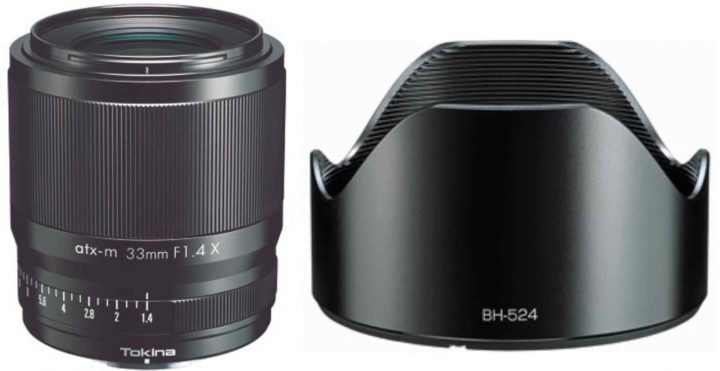
Nokishita leaked the first images and specs of the upcoming Tokina lenses for Fujifilm X mount here. The lenses will be released on December 11.

All details below:

Tokina atx-m 23mm F1.4

  • 60,500 yen including tax (converted this makes $582. The Viltrox 33mmF1.4 costs 35,900 yen at Amazon Japan)
  • 11 elements in 10 groups (same of Viltrox 23mmF1.4)
  • minimum focus distance 0.3m
  • filter size 52mm
  • φ65mmx72mm
  • maximum magnification 0.1 times

Tokina atx-m 33mm F1.4

  • 53,800 yen including tax (converter this makes $518. The Viltrox 33mmF1.4 costs 30,000 yen at Amazon Japan)
  • 10 elements in 9 groups (same of Viltrox 33mmF1.4)
  • minimum focus distance 0.4m
  • filter size 52mm
  • φ65mmx72mm
  • maximum magnification 0.1 times

As already for the Viltrox 85mmF1.8 and the Tokina 85mmF1.8, also in this case we are just in front of the same re-branded lens. In fact, as we reported in this article, Ben said:

Tokina and Viltrox are both working with a well established 3rd party Chinese lens manufacturer that creates prototypes and allows other companies to customize and sell their lenses under their own brand names.

And yet, even though they might be optically the same, there could be one crucial difference between both lenses that we reported about it here: Tokina has access to official Fujifilm AF lens protocols, and I am not sure if Viltrox has, too (they surely had not, when they started making X mount lenses).

  • read here: Sigma Says DC DN Lenses for Fujifilm X Mount will Hopefully Come in 2021

Follow FujiRumors on Patreon, Facebook, Instagram, RSS-feed, Youtube, Flipboard and Twitter

Join Our Owners Groups

Join Our Facebook Pages

Peak Design Launches its Biggest Sale Ever!

Peak Design has just launched its biggest sale ever.

The deal runs directly at Peak Design store and also at official retailers. If you are from Europe, you can purchase directly from the Peak Design store (as I always do) instead of BHphoto and Co.

Save up to $60:

Save 20% off every single :

Savings also on:

Adobe: 25% off Adobe Creative Cloud.

Notice of Fujifilm Application Software Used with macOS 11.0.1 “Big Sur”

Notice of Application Software Used with macOS 11.0.1 “Big Sur”

Nov 16, 2020
FUJIFILM Corporation

Thank you very much for using FUJIFILM products.
We have checked the performance of our application software used with “macOS 11.0.1 (Big Sur)” which was newly released from Apple. As a result, we have confirmed the symptoms described below.

We will fix the symptoms by upgrading the application software. And we plan to post the upgraded ones sequentially on our global website.
Therefore, if you plan to upgrade the OS, keep in mind that those symptoms will occur.
Your understanding is highly appreciated.

Applicable application

** CLICK HERE to Read the Rest of the Article **

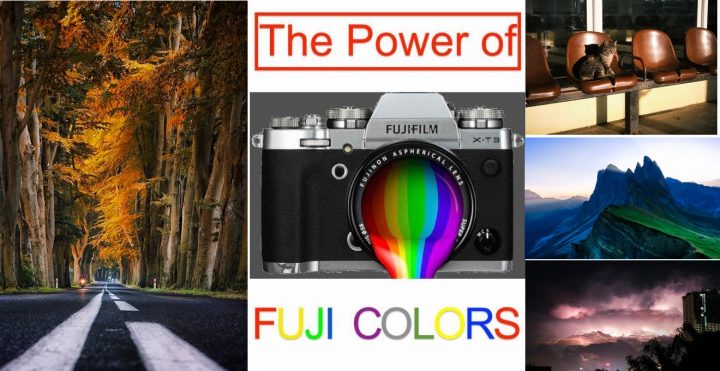
The Power of Fujifilm Colors: Why I LOVE Fuji Colors and See Them in Action at Our Film Simulations Group

I don’t know you, but when I look at an image, the first thing I notice is not how sharp it is at 400% magnification or how grainy it is at 12800 ISO.

Nope!

What first grabs my attention are subject/composition and colors. Those are the main “WOW” factors for me.

And while for the first one (subject/composition) no Fujifilm camera can help you and it’s totally up to the photographer to compose a pleasing image, when it comes to colors, Fujifilm cameras can be quite a good support for us photographers, and certainly they are for me.

Since I switched to Fujifilm (after a long journey searching for “my” system), I have quite radically changed (and speed-up) my editing-workflow thanks to Fuji’s film simulations.

I still shoot RAW+JPEG, I still adjust exposure, add sharpening here and there and make some other tweaks. But the more film simulations Fujifilm was releasing over the years, the less I found myself in the need to laboriously edit the color part of my images in order to set the right mood.

Not to talk of all those times, when the JPEG is just right out of the box, and I don’t adjust anything at all.

So yes, for me, Fujifilm film simulation make a whole lot of difference and are one of the main reasons why I love Fujifilm.

In order to celebrate Fujifilm colors, I recently launched the Fujifilm Film Simulation group, which has reached 10+K members in a very short time.

In this group, images can be edited in all their parts (sharpening, shadow/highlight recovery etc), except for colors. The colors must come purely out of your Fujifilm camera (or be applied in post in Capture One / Lightroom).

It is also allowed to share images that use custom presets, which means take a film simulation and fine tune its settings in-camera (increase contrast, add grain etc), creating your own receipts to store as custom profile inside your Fujifilm camera. Those are very fun to try out!

Now, since I am in total lockdown again (see me here chilling with my dog and cat at home), I have a bit more time this weekend and I decided to use it to go though the images at our Fujifilm Film Simulation group and pick out some of the most liked shots for you.

You’ll see images taken with all kind of film simulations, but you’ll notice that Classic Chrome and Classic Negative turn out to be the most shared and liked ones (or receipts derived from those film simulations).

But also ACROS, Velvia, Provia and one of my favorites, Astia, are also present down below.

Feel free to check out the images below and to join the group if you want.

NOTE: if you join the group and share images, do not forget to tell us which film simulation you used in the description of the image.

I wish you a fantastic weekend,
Patrick

Film Simulation Images Roundup

** CLICK HERE to Read the Rest of the Article **

Fujifilm X-T200 Discontinued After Just 9 Months at Some Stores – is This The End of Fujifilm’s Entry Level Line?


Fujifilm X-T200 Discontinued

The Fujifilm X-T200 was announced on January 23, 2020 and started shipping in February 2020.

Now, just about 9 month after its release, some stores marked it as discontinued (see image above for example – google translated)

To my knowledge, this is not happening because an X-T300 is on the way (at least I have not heard about it). The reason is probably very simple: it did not sell well at all.

The Fujifilm X-T200 is a very fine camera for its price, but it failed in its purpose: attack the best selling camera in this price segment, the rather old and yet still strong selling Sony A6000, which was released in 2014 and is still in top selling raking at AmazonUS (currently 22th).

In the entry level segment, the Sony A6*** line is apparently unbeatable, and Fujifilm was not able to break through with excellent products like the Fujifilm X-T200 or even the X-A7.

That’s unfortunate.

The Unbeatable Sony A6000

But what could be the reason for the failure of the X-T200 and the ongoing success of the Sony A6000?

Well, in part it could be quite simple: people in the market for such a camera are usually not big photography enthusiasts and have not a huge photographic culture. They mostly just buy a camera because they want to have something that takes better pictures than their smartphones.

Those people know the Sony brand very well from their TV’s, their PlayStation’s and other electronic products that they use in their daily lives already. It’s a brand they know and associate with quality electronic products, and they therefore grab a Sony A6*** rather than a Fujifilm, which is for them a rather unknown brand they can’t relate to at all.

The Future for Fuji’s Entry Leve Line

Is this the end of the entry level line-up of Fujifilm?

Well, as we discussed in an earlier article, that shows Fujifilm’s own 2020 Fujifilm camera range pyramid, I believe that sooner rather than later the whole entry level line of Fujifilm will be dropped. It’s not a rumor, to be clear, but just my evaluation after seeing how this segment has developed over the last few years.

The only entry level line that did sell strong for a while, was the X-A line. But it looks like also that one is suffering, forcing Fujifilm to discontinue the X-A7 just 11 months after its release.

I am very pessimistic about Fuji’s entry level line, which, as we also told you already back in 2017 here, is no longer developed by Fujifilm anymore, but by the Xacti corporation. This means that already in 2017 Fujifilm struggled to justify that line any longer, and outsourcing its development was a last move to try to safe the line.

With the Fujifilm X-T200 and X-A7 failing to meet their sales targets, I am just becoming even more pessimistic about the future of those lines.

It’s a pity, I have personally recommended the X-T200 to a few of my friends, and they are all happy with it. But the market is not rewarding the best cameras for the reasons we told you above.

Follow FujiRumors on Patreon, Facebook, Instagram, RSS-feed, Youtube, Flipboard and Twitter

Join Our Owners Groups

Join Our Facebook Pages