I do receive lots of email requests from fellow Fuji X shooters asking to be featured. And it is my pleasure to cut out regulary a space for you guys here on FujiRumors.
However, the requests are many, and the content on FujiRumors is overall very rich, so sometimes it takes a bit longer to be featured.
But I don’t forget any single one of you, and you’ll all be featured at some point. I just ask for a little bit of patience :).
There was a time, when Fujifilm was making its own sensors.
However, at some point in time, Fujifilm sold its sensor business to Toshiba, which later on sold it to Sony.
As of today (and as far as I know) Fujifilm only makes the color filter array for sensors. Fujifilm also cooperates with Samsung on the ISOcell+ sensor development, which we reported about here.
In short: Sony dominates the sensor market, and most camera manufacturers buy all the sensors they need from Sony.
This gives Sony a huge advantage, as Fujifilm managers Toru Takahashi and Toshihisa Iida said back in 2016 here:
Sony has a big advantage, they make their own sensors. That is a very big advantage for them.
FujiRumors got information years ago, that Fujifilm had a contract with Sony, that allowed them to use the latest Sony sensor only 6 months after Sony used them on their own cameras, giving them a strategic time advantage (timing is crucial in business).
I don’t know if this contract has been changed in the meantime, but what I know is that Sony officially said once, that they will keep the best sensors for themselves, and not sell them to other camera manufacturers.
Max Yuryev compares the Sony vs Fujifilm color science.
It’s a blind test, so you have to go through 10 frames, note on paper if you prefer camera A and B. Of course I did it, and it turns out I prefered Fujifilm in 80% of the cases.
The video frames from 1 to 4 are taken with standard picture profile, whereas from 5 to 10 he compares Eterna to a custom made picture profile.
Some general conclusions Max made, before we watch at the frames one by one:
in harsh daylight, with light bouncing, the Sony got some heavy tint, but Fuji’s smart color science got rid of it
Sony is usually more accurate, but you have to spend time to get rid of that tint
Fujifilm got it figured out, and you don’t have to worry about color tint
If you just want to shoot, and not spent time color grading, Fujifilm is great
We remind you that, as reported here, Fujifilm makes a distinction between metric color and memory color. Metric color is more realistic, whereas memory color is interpretation, it’s how your brain sees and remembers colors in a certain scene.
Certain Fujifilm film simulations are not ment to be accurate representation of real colors, but interpretations closer to how you remember those colors.
Other film simulations instead just have to give a unique vibe to the image, think at the vintage touch of the less saturated Classic Chrome for example, great for documentary photography, thanks to the “art of omission” that puts the story/content in the center, instead of colors.
Colors science is a crucial factor at Fujifilm, and we told you already that the engineer, who developed the original Velvia film, has also developed the digital Velvia film simulation.
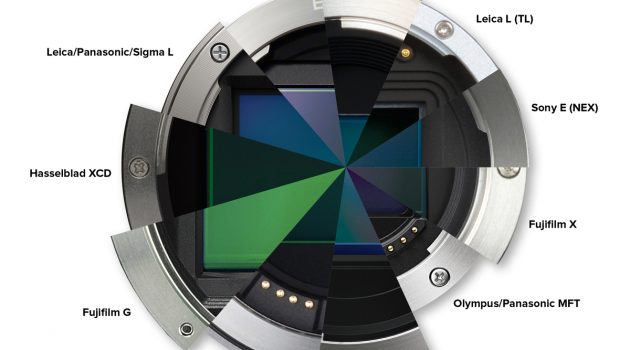
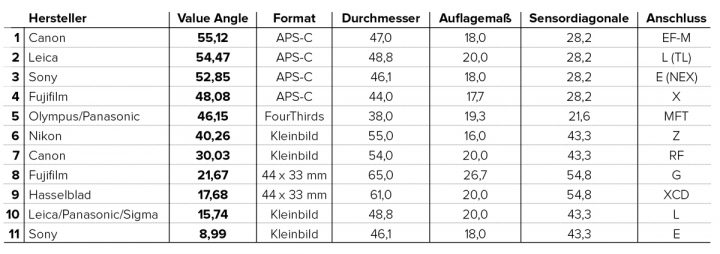
At the last Fujifilm X summit (which we covered and sumed up for you here), Fujifilm talked to us about the “value angle”.
The value angle is not a weird concept invented by Fujifilm, but a factor that influences the whole design and development of a camera system, as well as image quality.
In short: the wider the value angle, the more precise and easier a lens can send light to the sensor. A wider value angle gives more flexibility for lens design and allows for more light and less digital correction.
In German we refer to Full Frame as “Kleinbild” (small format)
If you want to get an anology with a soccer player hitting the ball, in order to understand it better, we can get the help of an article appeared at the German site docma many months ago.
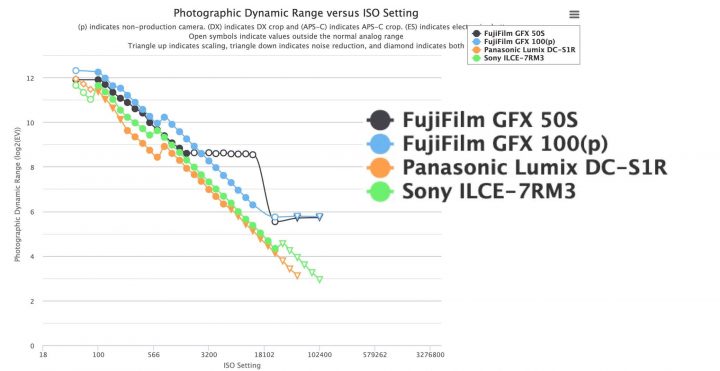
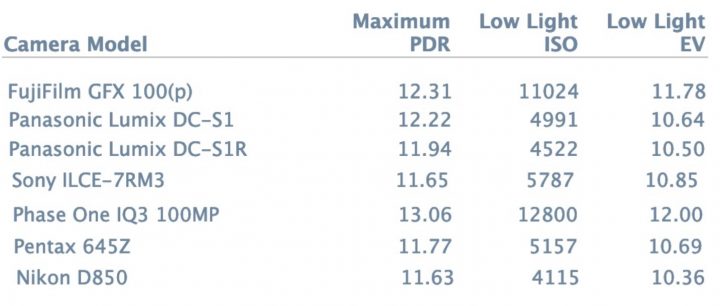
In terms of dynamic range, the 100 megapixel GFX100 beats all full frame cameras. If you need even more dynamic range, you have to pay $40,000 for a Phase One.
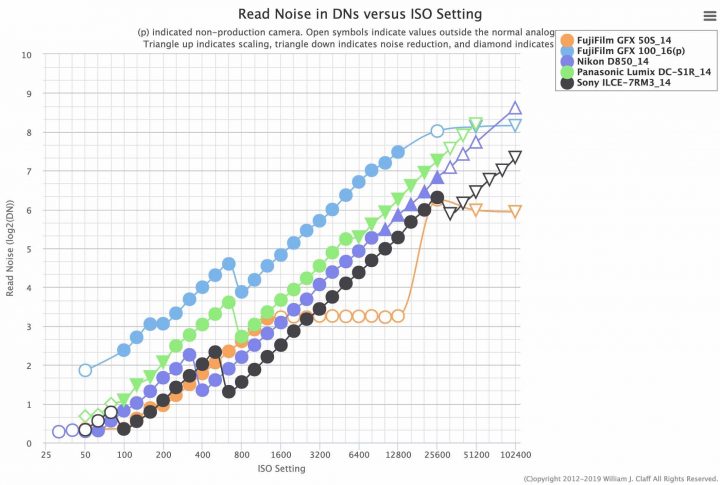
The bump you see at ISO800 is due to dual conversion gain.
Earlier today we shared the DPReview lab shots, which in my eyes showed impressive results in favor of the Fujifilm GFX100.