Here is more of the latest X-H1 content that appeared on the world wide web.
But the #1 source for all things Fujifilm X-H1 is our huge and hyperactive Fujifilm X-H1 Facebook group, where basically everything you see below has already been shared and discussed. Feel free to join. If all you want is to be notified about X-H1 content only, make sure to like our dedicated Fujifilm X-H1 facebook Page.
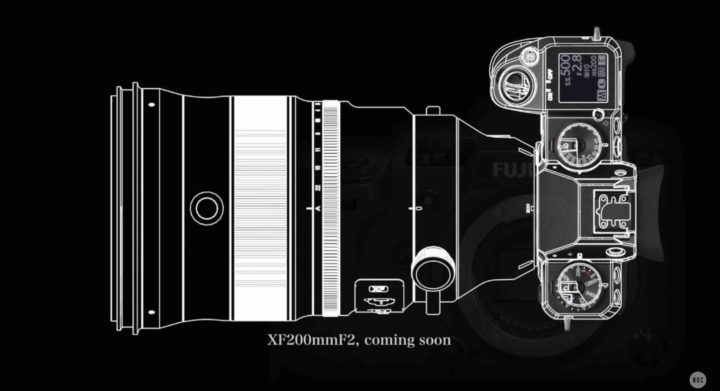
The article includes a technical sketch of the Fujinon XF200mmF2 R LM OIS WR mounted on the brand new Fujifilm X-H1.
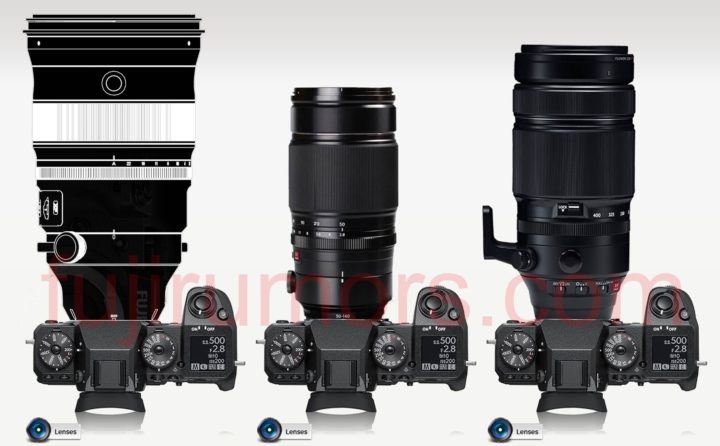
I used the technical sketch provided by Fujifilm (and camerasize.com) to photoshop a size comparison of the XF200mmF2 against the other big Fujinon glass, the XF50-140 and the XF100-400.
Keep in mind that there could be changes, since the sketch shows the current estimated size of the XF200mmF2. We are still in pre-production phase, so the final lens might see some changes.
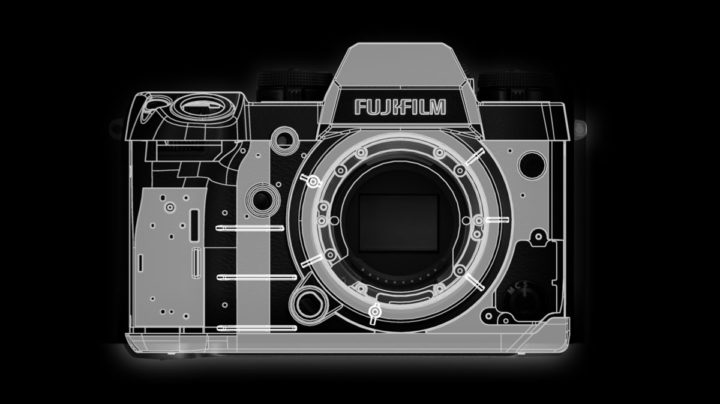
The article linked above also says the XF200mmF2 R LM OIS WR will weight more than 2kg and that in order to withstand the stress, the mount part of the Fujifilm X-H1 has reinforced ribs.
FR-reader Panther wonders if Fujifilm implies, that the mount of the X-T2 can’t handle that stress. I guess we will get more answers soon, when the XF200mmF2 will be announced (witihin 2018).
Fujifilm X-H1 with reinforced ribs for use with heavy glass
Fujifilm X-H1 Development Story
Fujifilm just published part 1 of their Fujifilm X-H1 development story.
“Let’s examine the X-H1. The product planner requested the developers to make the body more robust so that new devices could be installed and the expected camera performance could be realized. In order to make the body more robust, the frame, which is made of magnesium alloys, needed to be strengthened by adding extra thickness. The frame is 125% thicker for X-H1, meaning that the frame has almost doubled in volume (1.25 x 1.25 x 1.25 = 1.95). The strength of the frame is almost twice as strong.
Portability and lightweight are the charm of the X Series. This should always be taken into account even when considering an exterior design that is more robust. The designer examined the frame closely and learned where the stress is most/least applied and where the extra strength is most/least needed. With the study, the following structure with pillars jointing the exterior part has been realized, which helped minimize the effect on body size.
[…] In near future there will be lenses that weigh more than 2kg. [note: given that they show the XF200mmF2 in the article, it’s save to assume they meant the 200mm]
To withstand the stress, the mount part is reinforced ribs as shown below.”
Read the whole article and see all images at fujifilm-x
With the launch of the Fujifilm X-H1, Fujifilm also officially displayed sketches showing the XF200mmF2 mounted on the Fujifilm X-H1 at all press events worldwide, such as here at dc.watch or in this Italian youtube video, where they present the X-H1.
The Fujinon XF200mmF2 is “coming soon”, says Fujifilm. The official roadmap confirms it will be released within 2018.
In the video above you can see how much the X-H1 sensor wobbles, going behind the front plate. That’s impressive.
And you will remember, how Fujifilm said that X-mount is not compatible with IBIS, right?
So people wonder, how did Fujifilm manage to make it compatible and to make IBIS work on X-cameras without introducing to heavy vignetting?
Good question.
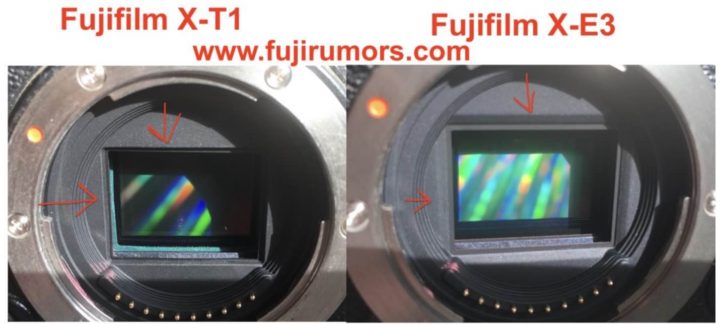
What we know, is that newer X-series cameras have a newly designed front plate. Just check out my old X-T1 with sharp 90° angle compared to my new X-E3 with a much more rounded angle. UPDATE: Older X-T2’s and X-Pro2’s have a very angled mount, while newer ones more rounded. Check it out, it’s documented also on dpreview ;) .
However, I heared another fascinating theory, that I want to share here on FujiRumors,.
The rounded angle could allow the light to filter better in the corners, and hence reach the sensor even better, when it goes behind the mount.
Wait… I hear you say… the X-E3 has no IBIS!
But, so the theory, since Fujifilm had to redesign the mount to accomodate IBIS on X-H1 anyway, it just hugly simplifies and speeds up the production line, if you use one front plate design for all cameras, instead of manufacturing 2 different ones.
However, this theory does not convince me fully, since the front plate on the X-H1 seems to be more similar to the one of my old X-T1 than the one of my X-H1.