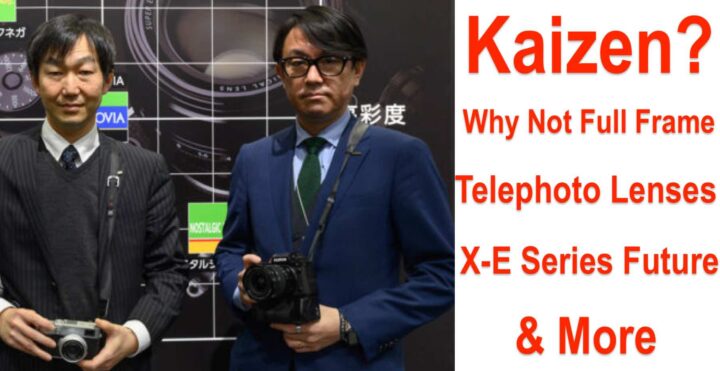
DPReview met up with Yuji Igarashi, Professional Imaging Group Manager, and Makoto Oishi, Head of Product Planning in Stockholm for the launch of the Fujifilm GFX100 II.
Here is a recap and below the link to the full interview.
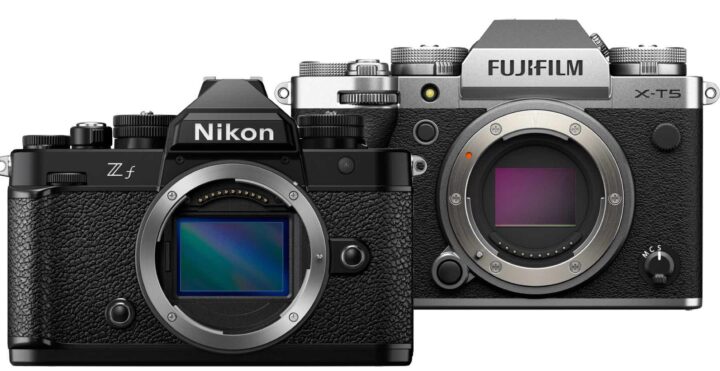
But since the buzz is big and many headlines compare it to Fujifilm’s retro approach (like our Italian friends at Promirrolress here that gave it the headline: “the Nikon Zf makes Fujifilm tremble“), I thought to launch a dedicated article mainly so that you guys can discuss about it in the comments.
My comment?
In short: I love what Nikon did with the Nikon Zf, even though there are reasons I still consider Fujifilm the better pick.
What Nikon did right
The problem is this:
Pretty much all mid and higher end mirrorless cameras you can buy today are excellent.
At the same time, there is not much innovation anymore in terms of sensors. The last big jump was achieved with the stacked sensor. Since then, we are still waiting for the next big thing (global shutter?), but that “big thing” seems to be still far away.
So the question is: what could motivate people to buy a new camera, if what they have is already so good and the new gear does not really bring groundbreaking new specs to the table?
Is a 20% faster sensor readout or a 10% higher autofocus accuracy really a reason to upgrade gear?
I don’t think so.
But what could work as a much bigger motivation to upgrade than a slightly faster sensor readout is to offer a completely different photographic experience over the mainstream thanks to dedicated dials, retro look and feel, vintage manual controls.
Because even if the camera might be identical in terms of specs to many other cameras, it will still be able to offer something completely different thanks to the retro approach.
Also, in times where camera companies have to find ways to draw younger generations into their systems, the retro style could be paradoxically something that achieves exactly that goal, as we can see from the terrific success of the Fujifilm X100V.
That’s why I believe the Nikon Zf will become a terrific success. It is the one thing that sets it apart from all other Nikon Z cameras (except for the Nikon Zfc of course).
Nikon Zf or Fujifilm?
The Nikon Zf uses the same 24MP sensor of the Nikon Z6II. And we know from Photons to Photos dynamic range measurements data, that it is marginally better in terms of dynamic range over the 40MP Fujifilm X-H2 with X-Trans sensor (Z6II has a PDR of 11.26 vs X-H2 a PDR of 10.75).
But that’s actually not the point.
Other aspects are more relevant. The Nikon Zf has:
no joystick
no dual UHS-II card slot
no awesome film simulations
lenses without aperture ring
less megapixel than X-T5
more than 30% heavier than my X-T5 (plus the bigger full frame lenses, without aperture ring)
Now these are just a few things that make the Nikon Zf not a temptation for me. But for many others these might not be an issue at all.
I am not bashing on the Nikon Zf. On the contrary, I applaud and welcome it, and it is the first camera from another brand that actually grabs my interest for more than just 5 minutes. ;).
I believe the Nikon Zf will become a terrific success. And I certainly wish it to Nikon. More vintage cameras on the market are always welcome and refreshing over the plethora of PSAM dial cameras out there.
This LUT file and IDT file is to edit the movie data below when the data is edited by a movie editor on your PC or Mac.
<F-Log 3D-LUT file / F-Log IDT file>
* F-Log movie data recorded with GFX100 II, GFX100S, GFX100, X-E4, X-S10, X-S20, X-T30 II, X-T30, X-T2, X-T3, X-T4, X-T5, X-Pro3, X-H1, X-H2S, X-H2 and X100V
<F-Log2 3D-LUT file / F-Log2 IDT file >
* F-Log2 movie data recorded with GFX100 II, X-H2S, X-H2, X-T5 and X-S20.
In 2023 we have so far spotted three Fujifilm registrations, with 2 items still to come
FF220002 = Fujifilm X-S20
FF230001 = very likely Fujifilm GFX100II
FF230002 = yet unknown
We know for sure that one of the yet to be released items will be the Fujifilm GFX100II.
So what could be the second one?
I’ve read all sorts of speculations, from the Fujifilm GFX50R successor, the Fujifilm X-Pro4, Fujifilm X-E5, Fujifilm X-T6, Fujifilm X-T40, Fujifilm X80, Fujifilm X-H3, Fujifilm X-H3S, Fujifilm X100VI or X200 and more.
But those “rumors” appeared also ahead of the X Summit on May 24, and of course none of it materialized.
Here on FujiRumors we avoid to share fakes for traffic and SEO. That’s why all we rumored so far for 2023 were the X-S20 (code name FF220002) and the Fujifilm GFX100II (probably the FF230001).
So yes, there is still one piece of gear, the FF230002, that should come this year. But which camera will it be?
Again, I have absolutely no rumors about other cameras coming in 2023, so an idea came to me:
What if it’s not a camera?
What if it’s something else?
Because keep in mind that these registrations don’t say anything about “cameras”, but about gear that uses some sort of WiFi/Bluetooth frequencies.
So, with that in mind, and given the lack of rumors for another camera coming in 2023, I see three options:
Fujifilm will launch a new camera with the code name FF230002 in 2023, but FujiRumors simply does not know about it yet
Fujifilm will launch a new camera with the code name FF230002 in 2024
Fujifilm will launch an X-H alike file transmitter grip along with the GFX100II on September 12, and the grip has the code FF230002
Now, I don’t have rumors about any GFX100II file transmitter grip, but I have rumors about the GFX100II having an optional (and not integrated) battery grip, which could make option 3 likely.
Sure, also option 1 and 2 are still open. Especially if on September 12 the GFX100 II will come without any file transmitter grip.
But as we documented here it usually takes Fujifilm not more than 4 months (in two cases only it took them 6 months) to launch a camera after the registration has been spotted. And since the FF230002 registration appeared back in June here, the likelihood of a 2023 launch is very high.
And sure, there can always be a surprise camera. Maybe scheduled for launch later this year, maybe in November (X-T5 was launched in November too). I am just a rumor site and don’t claim to always know everything that will happen in the Fujifilm world. But maybe you remember the famous Fujifilm camera roadmap shared by Fuji Spain, in which they displayed two “disruptive” cameras coming for 2023. Well, if that roadmap was accurate, then the X-S20 and GFX100II would be those cameras and we can’t expect anything else coming this year.
But if that was the case, if nothing else would not come in 2023, then don’t worry, because as we already told you, the start into 2024 will be bombastic ;).
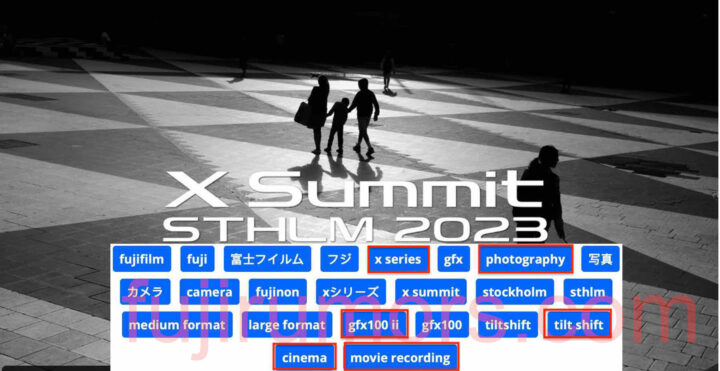
As soon as the video was up, I extracted the tags of the video and saw that the full tag-list included terms like “GFX100 II”, “tilt shift” and more (see screenshot above). I tried again now, and the tags that unveil what’s coming are no longer there.
So luckily I was fast enough to grab them for you. ;)
Now let’s go over them.
Let’s start with the tags that 100% tell us what’s coming September 12.
Fujifilm GFX100 II
Tilt Shift
According to my knowledge, also the Fujinon GF55mm f/1.7 should come on September 12.
Looking at the other tags gives us a sense on what the main focus of the event will be:
Now, there are no specific tags for Fujifilm X-Pro4, X-E5, X-S30, X-T6, X-T40, X-H3, X-H3S, X80, X100VI (X200) or whatever. So little hopes for any X series camera to come, otherwise they would have tagged it just like they tagged the GFX100 II.
But I’d already be very happy if behind that “X series” and “fujinon” would hide for example the unveil of a new X series lens roadmap, which is long overdue.
Anyway, overall a very GFX-centric event, with hope for X series tidbits too.
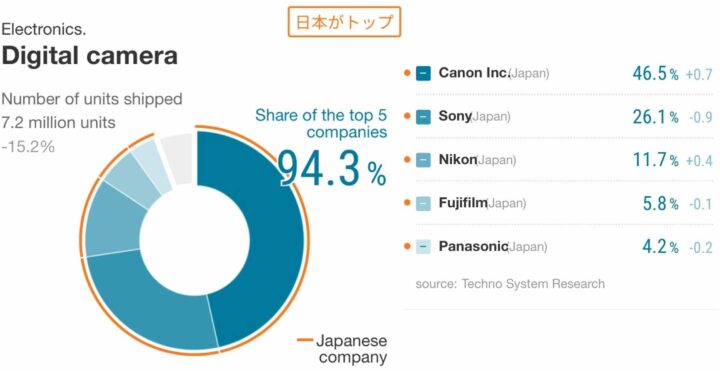
Every year, Techno System Research, a major marketing research company located in Japan, publishes the worldwide camera market share data.
And while the data is behind a (very expensive) paywall, the main chart (see above) for this year has been published by the Japanese Nikkei.
Digital camera 2022 global market share (compared to 2021)*Techno System Research
Canon 46.5% (+0.7%)
Sony 26.1% (-0.9%)
Nikon 11.7% (+0.4%)
Fujifilm 5.8% (-0.1%)
Panasonic 4.2% (-0.2%)
This is the data for the entire digital camera market.
I find the mirrorless ranking more interesting, as it is free of all those DSLRs Canon and Nikon still sells.
And I wonder where Fujifilm would rank, if they just would have been able to ship the X100V and pretty much any other camera that was basically never in stock even if just recently announced (see X-E4).
For mirrorless only, sadly no data had been published so far and not even in 2021, but this is the data we had for 2020
Sony: about 35%
Canon: about 30%
Fujifilm: about 12%
Nikon: about 7%
I hope they will offer again a separate ranking for mirrorless cameras.
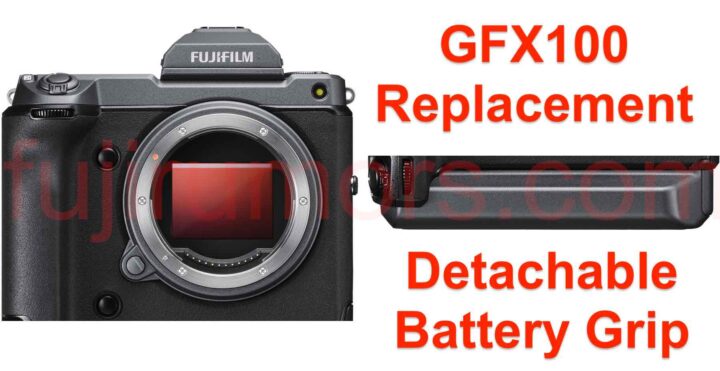
The Fujifilm GFX100 replacement is coming to end the moaning ;).
Let me explain.
When Fujifilm launched the original GFX100, it camera with an integrated battery grip.
This was welcome for those photographers, who love operating cameras with battery grips, but many others would have preferred a smaller camera without the built-in grip.
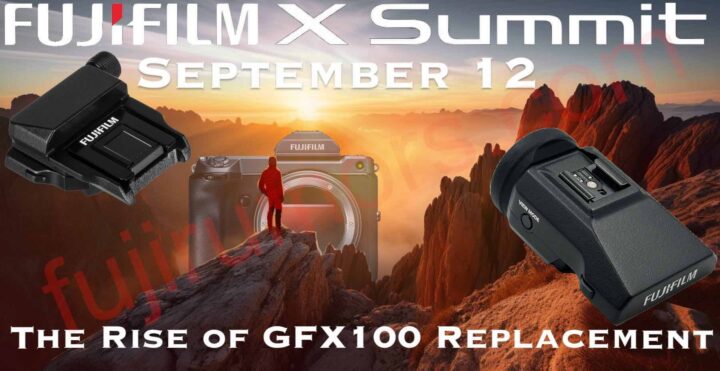
One of the features many loved when Fujifilm launched their original Fujifilm GFX50S, was that thanks to the EVF-TL1 and EVF-GFX, the camera had detachable and tillable EVF.
And the (also discounted) Fujifilm GFX100S did not even came with the tilt and detachable EVF, making quite some GFX lovers worry that Fujifilm had given up on this feature.
Fujifilm seems to be trying to takle the parts shortage more seriously compared to that creative (and failed) solution of using blockchain for that purpose.
Now, down below you can read the google translated version of their plan, which is not 100% clear, but I guess it overall simply means: we’ll get more parts from more suppliers.
On the 6th, Fujifilm announced the goal of expanding the target to a total of 30,000 parts of 30 suppliers by the fiscal year for digital platforms that optimize parts inventories such as digital cameras. We have been conducting verification for 4300 items from 8 companies since October last year, but we have started full-scale operation as we have been able to confirm the cost reduction effect such as inventory management.
Oh well, better late than never I guess.
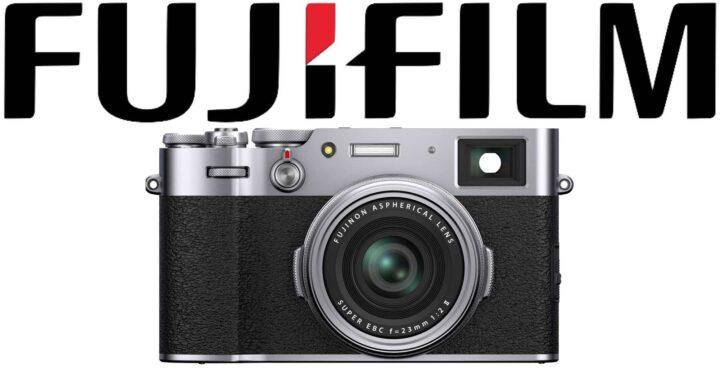
Let’s hope this will have positive effects also on the Fujifilm X100V, which in Japan is suspended since 8 months and as Fujifilm managers told us recently here, if the entire world would stop to order the Fujifilm X100V today, it would take Fujifilm still up to 3 months to manufacture and ship all the cameras already ordered until up to this point.
And quite frankly, there are plenty of other cameras that could benefit from a more stable parts procurement, maybe there could be even a revival for the Fujifilm X-E4, which was discontinued even though MANY of you had one on order. Fujifilm simply gave up on being ever able to ship it in a reasonable time.