Well, for your convenience I’ve made a summary down below and I’ll also give you time stamps so that you can jump to the section that interests you most.
NOTE 1: when he scrolls very quickly through the images you see them unsharp. This happens because his computer is not rendering at full res. When he stops on an image it gets rendered and it becomes sharp.
NOTE 2: I speak four languages, but sadly French is not one of them (although I understand it a bit). In case any French FR-reader notices an error or wants to add something, feel free to let me know in the comments.
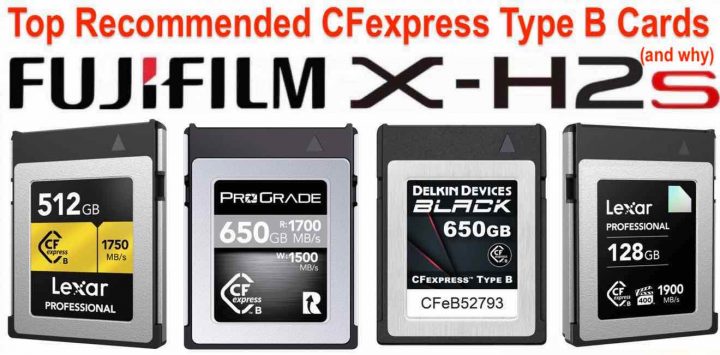
We just shared an article about the officially top recommeded CFexpress TypeB cards by Fujifilm and we saw that while many cards will work fine, not all of them will unlock the full potential of your Fujifilm X-H2S.
In fact, there are some that can’t record 6K/4K, other can, but not in ProRes, other have limited burst duration.
With the release of the Fujifilm X-H2S and hence Fujifilm’s first digital camera to take CFexpress cards, Fujifilm has updated its list of officially recommended cards to store your files.
Now, all the cards listed below are recommended.
But attention, not all CFexpress Cards are made equal.
Some CFexpress Type B Cards can’t record 6K/4K
Some can record 6K/4K but not in ProRes
Some can record all video formats, but when used for bursts don’t last as long as others
Also, CFexpress Cards not listed here are not properly tested by Fujifilm. This means they could perform very well, too. But they could also have a negative impact on the performance of the camera (or even don’t work with certain features).
This is important to know, as I have already seen reviewers using the Pergear CFExpress Type B card in their X-H2S first looks. Whatever those reviewers say in terms of performance, please take it with a grain of salt, as they use cards that are not on Fuji’s list.
If you treat yourself with a Fujifilm X-H2s, please stick to the recommended CFexpress Type B cards (and also UHS-II cards) listed below.