Fujifilm’s Sony-Level Autofocus Is Already Here — Hidden in Pre-Shot Mode, Waiting to Be Unlocked

Here We Are Again

When Fujifilm broke autofocus with last year’s firmware updates, Edvard was one of the YouTubers who delivered the most detailed, methodical, and technically grounded coverage of the issue.

Some people don’t like his tone. Others dislike the sarcasm or the way he presents his findings. That’s fine. None of that matters.

What matters is that his findings were legitimate.

And because they were legitimate, we shared several of his videos here on FujiRumors. And so we will do again today.

It’s a long video, which I will sum up below for you – a short version and a more detailed version.

Certain YouTubers Ignore Reality ;)

But before we get into the test results, I need to address something.

Sometimes, you hear accusations that “FujiRumors is a Fujifilm propaganda machine.”

I mention this now because in Edvard’s video, there’s a YouTuber who was “featured” and who, last year, claimed I deliberately don’t report on Fujifilm AF problems—that I only push propaganda.

There’s just one problem with that narrative.

Beyond the fact that when large YouTubers discredit FujiRumors it obviously hurts the blog’s reputation (you then see angry comments towards me), the real issue is something else:

At the time the YouTuber made those claims, I had already shared on FujiRumors his very own video in which he rants against Fujifilm autofocus—along with many other critical videos and several articles on the same topic.

That’s a textbook example of cognitive bias: ignoring observable facts, blanking out reality, and repeating a story that fits one’s pre-existing beliefs rather than what actually happened.

Facts, however, don’t care about narratives.
And FujiRumors will continue to report both the good and the bad—regardless of who finds that inconvenient.

FujiRumors exists for Fujifilm camera users, not for Fujifilm as a corporation. And that’s why, once again, we have to talk about autofocus.

The Findings in Short

NOTE: extensive summary of the 34+ minutes video below

Edvard noticed that in pre-shot mode – when you half press the shutter button and the camera starts saving images on the camera – the camera has a terrific autofocus.

Focus transitions from far to near (and back) are smooth and confident. Subject tracking is excellent. You can actually hear the lens making constant micro-adjustments, a clear sign that the camera is performing many AF calculations per second. There is no hesitation, no stalling halfway through a focus pull—just continuous, fluid, sold, sticky AF behavior.

In fact, it’s so smooth and fast that at minute 4:52 he literally says:

This is Sony-like autfocus, guys!

And that’s where the real problem emerges.

The moment you fully press the shutter, autofocus behavior changes. The camera appears to perform fewer AF calculations, the lens moves in larger steps, and the result is visible hunting—especially when transitioning between near and far subjects.

Interestingly, fast burst modes help. On his X-T3, shooting at 30fps with a 1/100s, Edvard reports “the smoothest tracking I have ever seen on a Fujifilm camera.”

Which leads to an unavoidable conclusion:

The autofocus performance is already there.

Fujifilm just needs to bring the Pre-Shot AF behavior to all shooting modes.

Conclusions

Rather than seeing Edvard’s video as an attack on Fujifilm, it should be seen as good news: the performance photographers are asking for already exists inside the camera. It just needs to be unlocked more consistently.

If Fujifilm manages to bring that Pre-Shot autofocus behavior to all shooting modes, then this discussion ends overnight—and Fujifilm autofocus suddenly becomes a non-issue for everyone.

And that’s exactly why it’s important to talk about these things.
The Test in Depth

** CLICK HERE to Read the Rest of the Article **

Sony Tricked You: The Sony A7V Does Not Match the Fujifilm GFX100II in Dynamic Range – UPDATED

The Sony Trick

UPDATES: Bill Claff made an error an apologised. Here are the true results and findings

Original Article:

Photons to Photos has published their dynamic range measurements for the Sony A7V.

As soon as the chart dropped, several Fujifilm GFX shooters in our group started wondering: is it time to ditch the GFX100 series and move to Sony?

Why the sudden doubt?

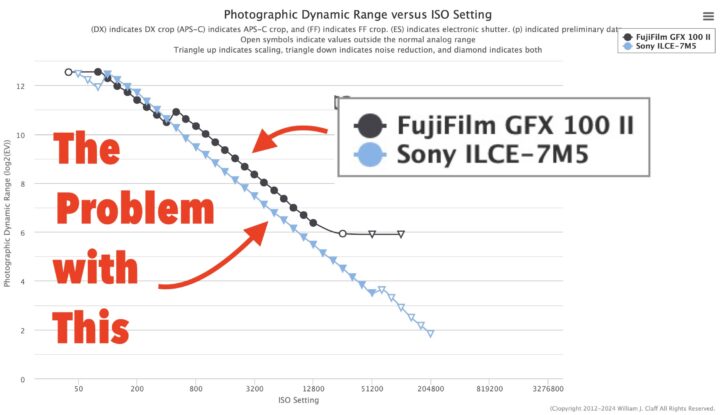
Because at low ISO values, the Sony A7V appears to match the Fujifilm GFX100II in dynamic range — at least according to the Photons to Photos graph here.

But there’s a trick. 😉

As Bill Claff (the mind behind Photons to Photos) explained over on DPReview here:

Note the triangles point down which indicated Noise Reduction (NR) baked into the raw files.

Also note, no Dual Conversion Gain (DCG) was detected.

Noise Reduction (NR) makes comparisons less reliable. Unfortunately it’s hard to gauge how much of an impact NR has on the results. Note there’s even stronger NR at the very high ISO settings.

That’s why the GFX100II shows simple dots, while the Sony A7V shows downward arrows: those arrows are a warning that NR is being applied to Sony’s RAW data — meaning the “true,” NR-free performance would be worse.

The real question now becomes: how strong is Sony’s NR, and how would the A7V fare against a GFX100II if both had the same amount of noise reduction?

Also a pity there is no dual gain conversion on the Sony A7V, because that helps to improve ISO performance at higher ISO. All modern (and even older) Fujifilm cameras have dual gain. This explains why the GFX100II jumps ahead to the Sony A7V at some point – even if the Sony is agressive with noise reduction – because dual gain kicks in on the GFX100II.

UPDATE: Bill Claff says “There will be ES results shortly at PhotonsToPhotos.net. And it does look like there’s High Conversion Gain (HCG) at ISO 1000 that is obscured by the NR with Mechanical shutter.”

The Fuji Trick

And because here on FujiRumors we take pride in being 100% honest and bias-free, let’s remember something before anyone starts yelling “SONY IS CHEATING!”

Fujifilm has played its own tricks, too.

With the Fujifilm X-Pro3, Fujifilm used a different method to make the camera appear to have better dynamic range than it actually did. And yes — we called it out immediately when the results came out.

So… hopefully this little reminder will help prevent the incoming sh*tstorm from Sony fanboys in the comments. 😉

The Best Deal on the Best Dynamic Range

** CLICK HERE to Read the Rest of the Article **

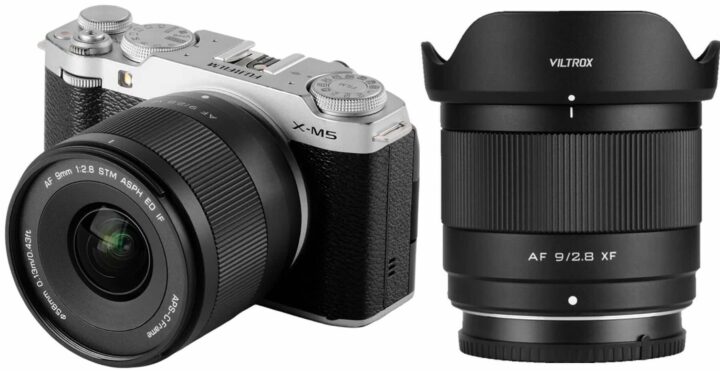
Viltrox AF 9mmF2.8 Air Reviews Roundup

The announcement of the Viltrox AF 9mm f/2.8 Air passed a bit under the radar due these days, due to the plethora of other news and rumors we have shared.

Now that it’s a bit more quiet, let’s take a closer look at it thanks to new reviews, that I will share down below.

The Viltrox AF 9mm f/2.8 is available for other mounts already since a while and so far it enjoys fantastic reviews:

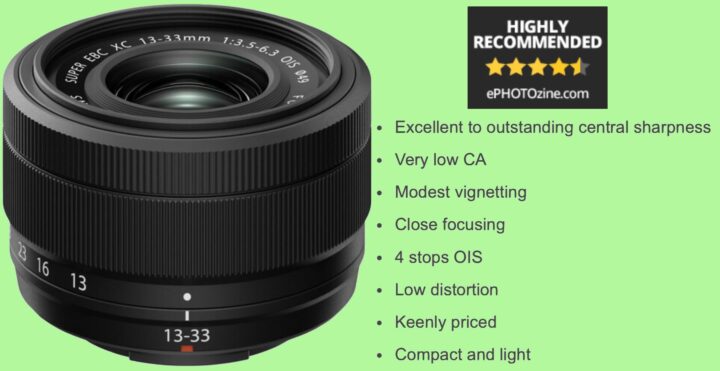
Fujinon XC 13–33mmF3.5–6.3 Review (ePz): “Super Little Lens, Outstanding Sharpness”

I was on one of my best hikes of the year in the Dolomites when I first shared the rumor of the Fujinon XC 13–33mm. Back then, the reaction was… lukewarm at best. Just another XC lens, many said—and not much different from the already familiar XC 15–45mm.

But things have changed.

The XC 13–33mm is shaping up to become one of the standout “best value for money” Fujinon lenses ever made, especially as more excellent reviews roll in—most recently the glowing evaluation published by ePhotozine:

Pros

  • Excellent to outstanding central sharpness
  • Very low CA
  • Modest vignetting
  • Close focusing
  • 4 stops OIS
  • Low distortion
  • Keenly priced
  • Compact and light

Cons

  • No weather resistance
  • No hood provided as standard

Verdict

If we want or need to travel light, but without compromising on quality, then the Fujifilm XC 13-33mm f/3.5-6.3 OIS lens could be just perfect for the job. It is light, compact, fast and reliable in operation, easy to handle, and stretches the wide end of the zoom range to a very useful 13mm (20mm equivalent). OK, it’s not perfect, edge sharpness does lag behind central sharpness. Even so, this is partly because the centre is pretty much universally excellent or even outstanding, so what might be considered a very high edge performance is somewhat eclipsed. Overall, images look crisp edge to edge, so in the real world where we are not constantly pixel-peeping, it is very satisfactory.

Probably the biggest negative for me is the lack of weather resistance, but then those who are routinely shooting images in sunnier climes than the UK will probably not see that as a problem.

Considering the aim of the X-T30 III with this new lens is a beginner’s kit, then it is hard to find fault with this super little lens, which as a result is Highly Recommended.

Purchase Options

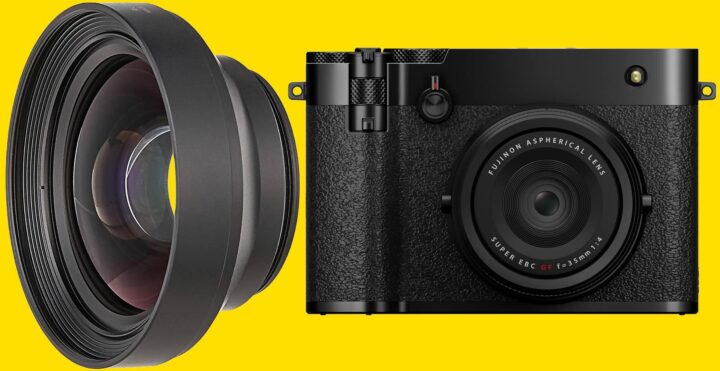
Fujifilm GFX100RF Wide Conversion Lens Option

Recently, I wrote an article about yet another WCL and TCL conversion lens set coming to the X100 system—this time from Viltrox. In that piece, I also expressed my hope that someone would finally create conversion lenses for the Fujifilm GFX100RF as well.

Well, while we don’t have any conversion lens specifically designed for the GFX100RF, it looks like the Ricoh GW-4 wide conversion lens actually works fine also on the Fujifilm GFX100RF.

I have found a video about it and also a blog post, you can find both of them below.

Summary of the video:

  • The Ricoh GW-4 wide-angle converter delivers surprisingly high image quality on the GFX100RF.
  • Sharpness remains strong, both in the center and corners, even with 100MP files.
  • Contrast stays consistent with the native lens; no noticeable loss in micro-contrast.
  • Minimal corner softness at typical landscape apertures (f/11–f/16).
  • Distortion is very low for a wide-angle converter and easily corrected when visible.
  • Flare control is good — lamps and bright light sources show no major artifacts.
  • Vignetting is minor and natural-looking, often negligible in real use.
  • Overall: delivers a clean, wide 21mm-equivalent image without the usual compromises of cheap add-on lenses.

Get Yours