
Sony Tricked You: The Sony A7V Does Not Match the Fujifilm GFX100II in Dynamic Range – UPDATED

The Sony Trick
UPDATES: Bill Claff made an error an apologised. Here are the true results and findings
Original Article:
Photons to Photos has published their dynamic range measurements for the Sony A7V.
As soon as the chart dropped, several Fujifilm GFX shooters in our group started wondering: is it time to ditch the GFX100 series and move to Sony?
Why the sudden doubt?
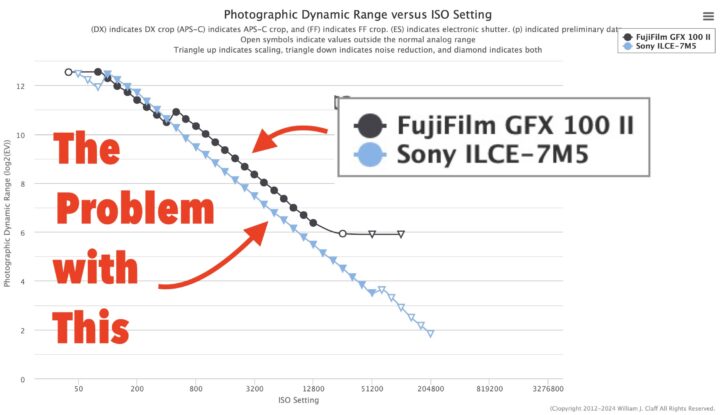
Because at low ISO values, the Sony A7V appears to match the Fujifilm GFX100II in dynamic range — at least according to the Photons to Photos graph here.
But there’s a trick. 😉
As Bill Claff (the mind behind Photons to Photos) explained over on DPReview here:
Note the triangles point down which indicated Noise Reduction (NR) baked into the raw files.
Also note, no Dual Conversion Gain (DCG) was detected.
Noise Reduction (NR) makes comparisons less reliable. Unfortunately it’s hard to gauge how much of an impact NR has on the results. Note there’s even stronger NR at the very high ISO settings.
That’s why the GFX100II shows simple dots, while the Sony A7V shows downward arrows: those arrows are a warning that NR is being applied to Sony’s RAW data — meaning the “true,” NR-free performance would be worse.
The real question now becomes: how strong is Sony’s NR, and how would the A7V fare against a GFX100II if both had the same amount of noise reduction?
Also a pity there is no dual gain conversion on the Sony A7V, because that helps to improve ISO performance at higher ISO. All modern (and even older) Fujifilm cameras have dual gain. This explains why the GFX100II jumps ahead to the Sony A7V at some point – even if the Sony is agressive with noise reduction – because dual gain kicks in on the GFX100II.
UPDATE: Bill Claff says “There will be ES results shortly at PhotonsToPhotos.net. And it does look like there’s High Conversion Gain (HCG) at ISO 1000 that is obscured by the NR with Mechanical shutter.”
The Fuji Trick
And because here on FujiRumors we take pride in being 100% honest and bias-free, let’s remember something before anyone starts yelling “SONY IS CHEATING!”
Fujifilm has played its own tricks, too.
With the Fujifilm X-Pro3, Fujifilm used a different method to make the camera appear to have better dynamic range than it actually did. And yes — we called it out immediately when the results came out.
So… hopefully this little reminder will help prevent the incoming sh*tstorm from Sony fanboys in the comments. 😉
The Best Deal on the Best Dynamic Range
Official GFX Gear Deals
- GF LENSES
- GF55mmF1.7 R WR – save $500
BHphoto / Amazon / Adorama - GF80mmF1.7 R WR – save $500
BHphoto / Amazon / Adorama / Focuscamera / Moment - GF110mmF2 R LM WR – save $500
BHphoto / Amazon / Adorama - GF20-35mmF4 R WR – save $500
BHphoto / Amazon / Adorama / Moment
- GF32-64mmF4 R LM WR – save $500
BHphoto / Amazon / Adorama - GF45-100mmF4 R LM WR – save $500
BHphoto / Amazon / Adorama - GF100-200mmF5.6 R LM OIS WR – save $500
BHphoto / Amazon / Adorama / Moment / Paul’s Photo - CAMERA BUNDLES
- GFX100 II + GF 20-35mm f/4 – save $1,000
BHphoto (+ freebies*) / Amazon / Adorama - GFX100 II + GF 45-100mm f/4 – save $1,000
BHphoto (+ freebies*) / Amazon / Adorama - GFX100 II + GF 100-200mm f/5.6 – save $1,000
BHphoto (+ freebies*) / Amazon / Adorama - GFX100 II + GF 55mm f/1.7 – save $1,000
BHphoto (+ freebies*) / Amazon / Adorama - GFX100 II + GF110mm f/1.7 – save $1,000
BHphoto (+ accessories) / Amazon / Adorama - GFX100S II + GF 20-35mm f/4 – save $1,000
BHphoto (+ freebies*) / Amazon / Adorama - GFX100S II + GF 45-100mm f/4 – save $1,000
BHphoto (+ freebies*) / Amazon / Adorama - GFX100S II + GF 100-200mm f/5.6 – save $1,000
BHphoto (+ freebies*) / Amazon / Adorama - GFX100S II + GF 55mm f/1.7 – save $1,000
BHphoto (+ freebies*) / Amazon / Adorama - GFX100S II + GF110mm f/1.7 – save $1,000
BHphoto (+ freebies*) / Amazon / Adorama
* freebies at BHphoto include a free CFexpress Type B Card and a camera bag