According to our trusted sources, the Fujifilm X-Pro3 will feature a “unique” tilt screen.
Not a fully articulating one (like we know it from Panasonic cameras), not a 3 or 2 way tilting one of current Fujifilm cameras, and not even the smart Fujifilm X-T100 tilt screen, but something different.
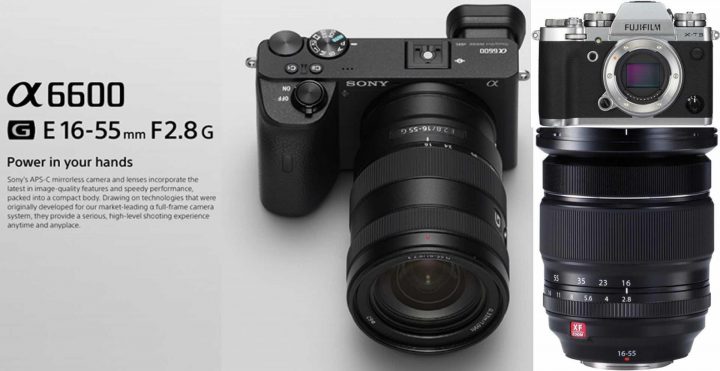
Personally I am very happy about the new Sony cameras, because in the high-end APS-C world, Fujifilm is basically without competition, and Sony is a terrific competitor, that I guess we all very much welcome.
But more than the two new camera bodies, I am particularly happy to see they also announced some interested lenses:
With Sony now treating with some fine camera bodies and lenses their APS-C system again, I can only hope that Fujifilm will step on the gas again, too.
In fact, this year, we got only 2 lenses for the X system (and one in the current roadmap for 2020):
Now that’s just my opinion, but releasing more cameras than lenses in one year is just wrong.
Fujifilm should focus again on giving us more lenses! And as our recent mega-lens-survey showed, Fuji X shooters definitely have lots of unfulfilled needs there.
So it’s nice to see Sony coming out with some fine APS-C lenses. This might push Fuji to speed up their lens development.
The inevitable question that pops up in the comments when this happens, is how long the time span is between registration of a camera and its announcement.
To answer that, I looked back to the past time span between registrations and announcements, and here is what we see:
1 month = 4 cameras (X-T2, X-E3, X-T100, X-T30)
2 months = 3 cameras (X-T20, X100F, XF10)
3 months = 3 cameras (X-T3, GFX50R, GFX100)
6 months = 1 camera (X-H1)
It’s clear that we usually get a camera between 1 and 3 months after registration (with exception of X-H1, which needed 6 months).
Clearly this would indicate of 3 cameras coming within November, although the X-H1 shows that a longer wait is not impossible, hence an announcement within February 2020 (6 months).
What could these cameras be?
The contact form on FujiRumors is open for any hint (thanks), and the comments for the wildest speculations :).
check out here – Release Timeline for Fujifilm X-T4, X-H2, X-T40, X-Pro3, X100V, X-E4, X-T200 and X-A6 Based on Fuji’s Previous Camera Releases
I do receive lots of email requests from fellow Fuji X shooters asking to be featured. And it is my pleasure to cut out regulary a space for you guys here on FujiRumors.
However, the requests are many, and the content on FujiRumors is overall very rich, so sometimes it takes a bit longer to be featured.
But I don’t forget any single one of you, and you’ll all be featured at some point. I just ask for a little bit of patience :).
Keep in mind that this camera replacement timeline is NOT based ON RUMORS, but on past camera release schedule of Fujifilm.
Hence, take it with a grain of salt, especially when it comes to Fujifilm X-H2 and Fujifilm X-T4 release. The timing between X-H1 and X-T3 has proven to be very damaging for X-H1 sales, so there might be some changes here.
In fact, according to our sources, the Fujifilm X-H2 might not even come in 2020! But I want to wait for more details and confirmations, before changing the below timeline.
Speaking of X-H2 and X-T4, the FujiRumors community has voted on various Fujifilm X-H2 and X-T4 release timing options. Check out the poll results here (I voted for the option currently on the 3rd position).
In fact, we are more likely used to see Fujifilm extending deals, but this time (and for the first time), Fujifilm has shortened the duration of the deals, which now expire July 6 instead of July 27.
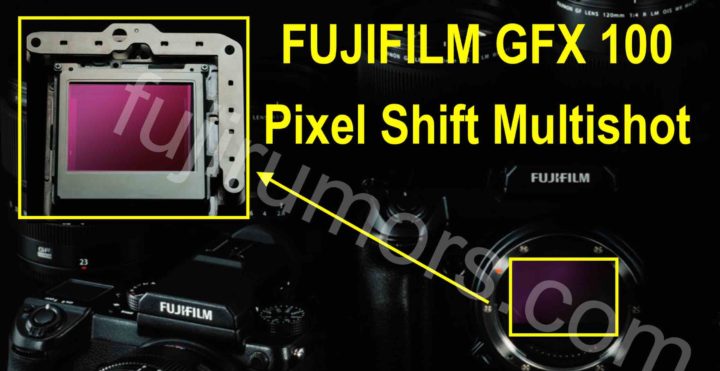
Back in October 2018, I told you the Fujifilm GFX100 will have pixel shift multishot. However, in March 2019 here, I got an update from a source, that pixel shift multishot won’t be ready for launch.
I have asked sources about this feature again, and they told me it is high on Fuji’s To Do list, but it will be only released once working perfectly.
I asked for a time frame, but the source could not give it to me. All it said is that it’s “just a matter of time“.
Pixel shift multishot is easier to achieve with Bayer CFA than with X-Trans CFA, which is why the Fujifilm X-H1 still does not have it, and I would not be surprised to see it coming first to the Fujifilm GFX100.
FYI: Another advantage of Bayer, is that also the electronic image stabilization (available in Fujifilm X-T100) is easier to achieve than with Bayer.
A bit out of topic, but Google just shared a white paper and video explaining their multi-frame super resolution feature that is what powers the Pixels’s night mode for example.
A good reminder that technology is not waiting and will always continue, and that Fujifilm should take note of it!