
How Sony Is Rewriting Dynamic Range Sensor Performance (DGO vs DCG) — And the Hidden Drawbacks You Need to Know

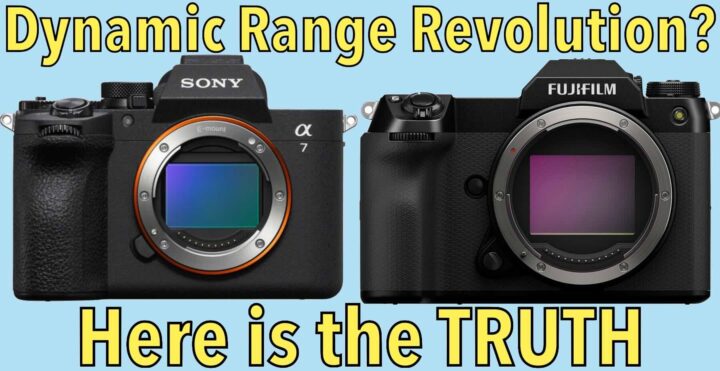
Dual Conversion Gain (DCG) – The “Old” Tech
First things first: what exactly is Dual Conversion Gain?
Modern camera sensors — Fujifilm included — operate in two modes:
- Low conversion gain: used at lower ISO values
- High conversion gain: activated automatically at higher ISO values (for example, ISO 500 on the GFX100 II)
Let’s look at the Fujifilm GFX100 II dynamic range data using Photons to Photos data:
- ISO 400 → 10.49 stops DR
- ISO 500 → 10.91 stops DR
- ISO 640 → 10.62 stops DR
Why does dynamic range increase at ISO 500 and ISO 640 compared to ISO 400?
Because that’s the point where the camera switches into high-gain mode, which reduces read noise and produces a DR “bump.”
For years, this dual conversion gain jump was the key method to maximize sensor performance.
But that changed—recently, and dramatically—with the launch of the Panasonic S1II first, and now also with the Sony A7V.
Dual Gain Output (DGO) – The New Tech
With the Panasonic S1 II (Sony-made, partially stacked sensor) and now the Sony A7 V, something unusual appeared in the data:
- No visible DCG boost at higher ISOs
- Exceptionally strong dynamic range at very low ISOs (ISO100 to ISO320)
That’s not what we normally expect.
At first, Bill Claff (Photons to Photos) suspected RAW-level noise reduction, similar to what Canon uses to artificially enhance DR.
This does happen on the Sony A7 V — but only adds about 1/6 EV (src-digicame-experts), and it may cost detail.
But the truth is that most of the DR boost comes from something else: Dual Gain Output (DGO).
Dual Gain Output in simple words:
The Sony A7 V and Panasonic S1 II read each pixel in the lower ISO range twice at the same time:
- Once with low conversion gain
- Once with high conversion gain
Then the camera combines both signals.
That’s why you don’t see the dual conversion gain boost: Sony and Panasonic use low and high conversion simultaneously, which improves dynamic range at very low ISO range.
And this is absolutely awesome!
Dual Gain Output – The “Serious” Limits
But as with every tech, also this one has its limitations and in some cases also disadvantages.
1. DGO is only useful at very low ISO
On the Sony A7 V:
- From ISO 100 to ISO 320 → about 1 stop DR improvement over A7 IV
- From ISO 400 upward → no advantage over the older A7 IV as you can see from this chart.
By ISO 500, the Fujifilm GFX100 II (with “old” DCG) is already ahead by a clear margin.
Because at mid and higher ISOs, plain old high conversion gain is still king.
2. DGO offers no benefits with electronic shutter – even has some disadvantages
First off: there is no DGO when using electronic shutter. The camera reverts back to classic DCG.
This means that with electronic shutter enabled, the Sony A7 V loses 1.5 stops of dynamic range at low ISO compared to when used with mechanical shutter.
Even worse when using electronic shutter:
- On the A7 V, high conversion gain doesn’t activate until ISO 1000
- On the A7 IV, high conversion gain kicks in already at ISO 400
This means:
- Between ISO 400–800 → the old A7 IV has 1 stop more DR than A7 V when using electronic shutter
- Only at ISO 1000 → A7 V catches up with its mechanical shutter performance (and with A7IV)
- Even then → A7 V is no better than A7 IV
In short:
DGO is useless with electronic shutter — and can even be harmful.
Summary
Dynamic Range
- if you want the best dynamic range across the entire ISO range, GFX is still king, especially beyond ISO500
DGO advanatges
- Excellent dynamic range at low ISO
DGO limitations/downsides:
- No DR benefit above ISO 400/500
- No DR benefit at all with electronic shutter
- Up to 1.5 stops DR loss with e-shutter compared to mechanical shutter
- the old Sony A7IV gives you about 1 stop more dynamic range than the brand new Sony A7V between ISO400-800 if you use electronic shutter
In short: DGO shines at ISO 100–320 with mechanical shutter. Beyond that, its value drops sharply – and can be even harmful.
Still, despite the limitations, DGO can be fantastic — especially for photographers working at base ISO with mechanical shutter.
The Fujifilm Future
Will Fujifilm ever use the DGO technology?
I have no idea.
But what we know:
- Sony is selling DGO capable sensors to other brands (e.g., Panasonic S1 II)
- Therefore, Fujifilm could potentially adopt it too
And interestingly, the DGO electronic shutter issues might actually show up less on Fujifilm APS-C cameras.
Why?
Many DGO disadvantages are triggered when you must switch to electronic shutter.
But considering that current top-tier Fujifilm APS-C cameras can shoot up 15fps with mechanical shutter – the Sony A7V only at 10fps – Fujifilm photographers shooting fast action would have less often the need to switch to electronic shutter, avoiding DGO’s biggest weakness.
And GFX?
Welll, the Fujifilm GFX system is not known to be meant for fast action sports photography anyway. It’s used mainly in mechanical shutter anyway, and it would profit from a 1stop DR boost at very low ISO. For example, Fujifilm could put even more megapixel in the GFX and at the same time also increase dynamic range.
Learn More About DGO
I have based this article on some of the best technical resources you can find on the web.
- The German website (and author mjh) at digicam-experts. If you want to learn more, I invite you to read this article and this article.
- The video of Horshack you can see below
- The data provided by Photons to Photos