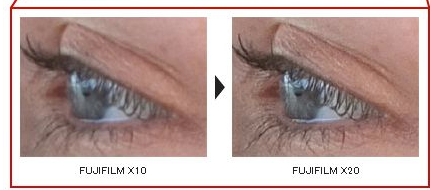




X10 vs X20 image comparison?
(click here to see the whole image)
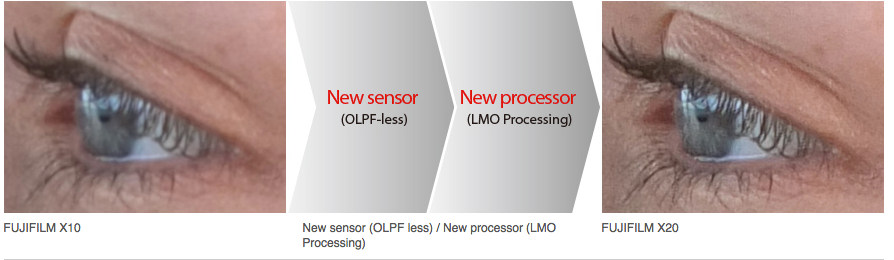
That’s a terrific improvement! Look at the image comparison between X10 and X20 posted on thenewcamera here (from the Fuji catalogue). Now low-pass filter, new sensor and incredible fast autofocus. The results seem to be great. Let’s wait for the first accurate reviews of the X20… but it’s all just a simulation!
Some Fujirumors readers were wondering if this comparison is real… the images are identical! But “see the bottom of the page [of the catalogue or Fujfilm X20 page]. Like always, on the feature pages it says: *Sample photos are simulated images.” (thanks MJr). So here is the “simulated” comparison. Hey Fuji, what about a real comparison? Maybe we have to wait for the first reviews to see some.
PREORDER
X100S: AmazonUS / Adorama / B&H
X20: AmazonUS: silver and black version / B&H: silver version – black version / Adorama: silver version – black version
Europe: UK: Wexphotographic X100s for £1099 / X20 silver and black for £599
__________________________________________________________________________________________
__________________________________________________________________________________________


mike kobal
5 months ago |looks impressive!
duo
5 months ago |Pretty sure this is simulated, not a real comparison.
MJr
5 months ago |No question about it. An eye cannot have a pixel-perfect match when actually using two cameras.
http://www.fujifilm.com/products/digital_cameras/x/fujifilm_x20/features/page_02.html
See the bottom of the page. Like always, on the feature pages it says:
*Sample photos are simulated images.
Same story for the X100s:
http://www.fujifilm.com/products/digital_cameras/x/fujifilm_x100s/features/page_02.html
It’s noted on the last page of the brochure as well.
alberto
5 months ago |Sorry but this is not actual image samples from the camera, its from fuji own catalog
yc
5 months ago |i’m sure there is an improvement, but i’m not sure about this sample authenticity.
the images are identical. if i’m to assume the photographer took two images and compared them, then there would some slight movement in the eyelashes. even if they were shot side by side remotely, there would be some angle differences.
where exactly does it mention the source of this comparison?
Fr3d3ric
5 months ago |Mmm How can you have the exact same photo with two different cameras? ^^
Lucas
5 months ago |If you look closely, then you’d see that these two pictures of the eye are too much alike to be taken with a different camera. I think it’s a photoshop job
Evgeniy Korol
5 months ago |100% fake! Just added in Photoshop contour sharpness, why is it cheat?
evgeniykorol
5 months ago |the only thing I can say, without harshness picture looks better in print, with sharpness, for publication on the Internet. On the details of this false comparison is not reflected, just added the sharpness of edges: (
Sharkfeeder
5 months ago |The Lightroom Punch preset will do the same thing.
Lee
5 months ago |You clearly have no idea what you r talking about.
mike kobal
5 months ago |of course it’s fake, its a simulation. but I can honestly say that-hypothetically, if this would be a crop from a the d800 and d800e file it would represent the real life gain from loosing the aa filter
let’s hope the new sensor really is that good
MJr
5 months ago |Yeah it’s fake but they not lyin boy !
Lee
5 months ago |This Lens Modulation Optimizer thing, is explained right here:
http://fujifilm-x.com/development_story/en/processor/
“…
The technology newly developed as a solution was signal processing by the optimization filter which matched the characteristics of each lens. This is the Lens Modulation Optimiser technology which restores an out-of-focus image into its original state.
The optimization filter (a type of signal processor) used for the Lens Modulation Optimiser was designed encompassing the focal length and aperture for each lens, as well as data from the center of the screen to its edges, and including calculations. This enormous amount of data requires just as much know-how to handle its processing. These were made possible because Fujifilm develops all of its lenses, sensors and processors. Advances in signal processing circuit technology allowed this achievement to finally become a reality.
…”
That sounds kinda like deconvolution. And deconvolution-ish solution is not what we usually mean when talking about sharpening.
As for the sample picture, of course its fake (not necessary a PS work). It’s just to show you the idea.
MJr
5 months ago |That’s interesting. Sounds like they fix the lens’s shortcomings in resolution with very exact calculations about diffraction aperture and focal length. The corners with large apertures, and diffraction with small apertures.
They make it sound like they process a ‘signal’. But isn’t it simply a very detailed lens profile ? The same way distortion and vignetting is corrected with every other compact in the world. In any case, if they do it well, and it sounds like they were really paying attention, then it can make a huge difference. But as RAW was never mentioned, i assume this is ‘just’ a new and improved JPEG processing.
Tho that is a great thing. The old X100 actually had a modified sensor which corrected for the light coming in at an angle in the corners. Normally resulting in soft corners. This of course should benefit RAW as well. Something they could do because the lens does not change focal length. But if they did this with the x-trans version as well you’d think they would flaunt about that again.
“Lower apertures can be used without worry thanks to the Lens Modulation Optimiser technology, even for scenes that could not be stopped down. As for situations that make you hesitate to zoom in all the way for fear of diffraction, this technology allows you to use apertures up to F16 for FUJIFILM X100S (fixed single focal length lens) and up to F8 for FUJIFILM X20 (zoom lens), providing ample opportunity to show the function of their lenses. Combined with X-Trans CMOS II Sensor’s high image quality which does not require a low pass filter, this allows you to take crisp images whether the diaphragm is fully open or almost closed”
lee
5 months ago |Also DCWatch posted a few interesting images here:
http://dc.watch.impress.co.jp/docs/news/20130110_581227.html
And this pictures show you the flow of such post process:
http://dc.watch.impress.co.jp/img/dcw/docs/581/227/html/007.jpg.html
Bad according to that article, this LMO is only for OOC JPG, not Raw files. I could be wrong coz I use Google translator to help me understand Japanese.
MJr
5 months ago |Thanks. DC Watch is always interesting, even just the images.
Guess i’d have to start paying attention to the JPEG settings and maybe i’d even forget about RAW. Always nice to have improved JPEGs OOC.
Gianluca
5 months ago |…very very sad marketing…
MJr
5 months ago |Maybe so to those hanging out at a rumors site, but to the average human actually the best way to make things clear enough to understand instantly, as simulations are free from any unrelated confusing factors, but make the point.
mark
4 months ago |2 cams, one an x10, the other an x20 set up on a tripod, inches from each other. The distance, which is more than the crops indicate, help to reduce the difference in viewing angles of the 2 cams. But if it says simulated, dunno.