There was a time, when Fujifilm was only offering rangefinder X series cameras.
Well, that’s if you don’t consider this camera here, which I guess we’ll never know why Fujifilm called it an X series camera.
But anyway, rangefinder was Fujifilm’s quiet re-entry in the mid-higher end digital camera market (their previous attempt was this one).
And silently, on tiptoes, Fujifilm carved out its very small niche of truly passionate photographers.
The X-E1 is Born
The Fujifilm X-E1 was definitely one of the best expressions of this understated approach into the mirrorless camera market: no thunders, no specs brags, just beauty and joy encapsulated in a wonderful camera body.
But the Fujifilm X-E1 would become the last X-E camera with a relatively quiet and tranquil life.
Because Fujifilm’s priorities started to shift, their ambitions to grow, and the X-E line started to be on the edge of survival.
Fujifilm had the brilliant idea to launch the Fujifilm X-E2 just 3 months before they announced the Fujifilm X-T1, which came in the more popular SLR styled package and offered superior specs like weather sealing, UHS-II card slot and the largest EVF on any mirrorless camera.
The X-T1 was Fujifilm’s statement to the photography world: we want to go more mainstream now! And as a consequence it stole the show (and sales) to the X-E2.
The Fujifilm X-E2 was followed by the Fujifilm X-E2S, which is basically an X-E2 with an auto button. So we can ignore that one.
And what has the Fujifilm X70 to do with the rumor we share today?
Well, the X70 is the prime example on why rumors about the price of upcoming gear are the trickiest to share.
Because not only Fujifilm can change the price of new gear until just a few days ahead of its announcement. But as we could see with the Fujifilm X70, Fujifilm can change the retail price on gear also just a few days after its announcement. Because that’s what happened with the Fujifilm X70, which was launched at $799 but just a few days later, while it was still on pre-order, Fujifilm lowered the price to $699 as we reported here.
So should FujiRumors never share price rumors ever again?
Nope… but we give you this important disclaimer. And with that said, we can share the rumor.
According to information we have received from our sources, the price for the Fujifilm GFX100RF should be “around 5,000 USD“.
That’s more affordable than what I consider to be its closest competitor, the Leica Q3.
Here are the top 10 articles for November. Interestingly, the rumor about the Ricoh GR IV and GR IV M is by far the most read article, which proves my point even further: we need a monochrome Fujifilm as soon as possible and we need a Fujifilm X70 successor. There is a huge interest for such cameras, and Fujifilm should grab a piece of that market share before it is too late.
Countermeasure for FUJIFILM Camera Remote Connection Failure
Dear FUJIFILM Camera Remote customers,
We would like to thank you for your continued patronage of Fujifilm products.
We are pleased to announce that we will release the revised firmware for our digital cameras (GFX series and X series) today to address the issue we announced on October 11, 2024, via our website in “About FUJIFILM Camera Remote’s iOS18 support”.
This revised firmware will also fix the same issue with the latest Android smartphones that we confirmed.
On the other hand, we decided that we would not release the revision for some models. Although we have been trying to fix this issue with these camera models, unfortunately we could not provide the revised firmware for these models due to the hardware limitations of the cameras, as they had been on the market for a long time.
Therefore, customers who use these cameras, please refer to the work-around solutions below, because FUJIFILM Camera Remote will no longer be available for these models.
We apologize for any inconvenience this may cause and ask for your understanding.
Guys, do yourself a favour. Get the newer Fujifilm X App instead of the old app.
But if for some reason you are still using the old App (and if you do so, tell us why in the comments), Fujifilm is aware of the issues with iOS 18 and they are going to fix it. You can read the full statement below.
We have been informed by a source, who was right in the past (THANKS), that there will be an improved hybrid viewfinder on the X-Pro4/X-Pro5.
I don’t know yet what the improvement will look like. Is it just a higher resolution EVF? A larger viewfinder?
But what I really hope is the same what Thomas B. Jones said in his latest X-Pro5 whishlist video (see below in German): the return of the slot-in magnifiers.
So what’s that?
Well, if you are not familiar with the X-Pro line, up until the Fujifilm X-Pro2, the X-Pro line offered a slot-in magnifier for 0.36x and 0.60x magnification mode in the OVF.
This has been changed on the Fujifilm X-Pro3, which offers a fixed 0.52x magnification which is great if you are shooting with Fujifilm’s 23mm, 33mm or 35mm lenses (which most X-Pro users do).
However, with lenses like the Fujinon XF18mmF1.4, the image that hits the sensor is larger than the one that can be displayed on the OVF.
The return of the slot-in magnifier could solve this problem and make the XF18mmF1.4 the perfect match for the next X-Pro camera.
But again, I do not know what the change the hybrid viewfinder will have, nor if it will be something minor or major. But if I hear anything more, I will let you know here on FujiRumors.
When yesterday we published the comments of Fujifilm CEO, who said that it is very difficult to mass-produce Fujifilm cameras with retro dials, there were some who said that making a retro dial is just as quick and easy as making a PSAM dial.
Is it true?
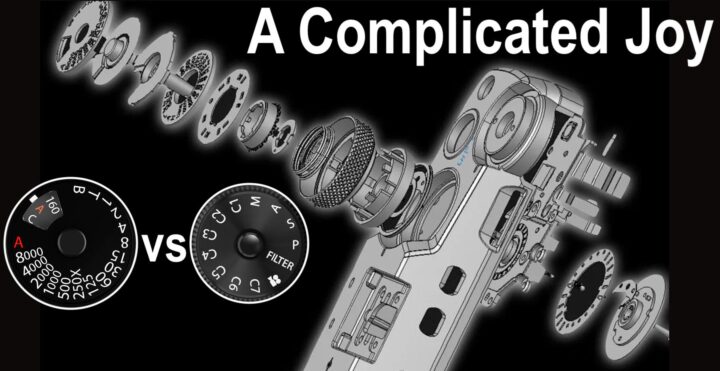
Well, the CEO was referring to the production struggles of the Fujifilm X100VI, which uses the combined ISO/Shutter dial first introduced on the Fujifilm X-Pro2.
So let’s look at that dial. Is it really as easy as making a PSAM dial? Here is what Fujifilm writes about it:
Realizing the [dial] mechanism and manufacturing process were not easy.
Firstly, […] there are 22 positions in total, quite a lot of number for an internal dial. […]
Secondly, the dial is electronically linked. The analog dial operation is converted digitally to know exactly what the setting is.
And Lastly, this mechanism has to be weather-resistant.
In order to meet the requirement, the Shutter speed / ISO dial required 38 parts for its composition. This number is the fourth largest after the finder, shutter unit, and mount.
This is not only about number of pieces, some parts required highly tech solution to manufacture the piece.
For example, in order to achieve the accurate 22 positions, the piece needed to be very precise and durable regardless of its complicated form. This piece is realized by a method called Metal Injection Molding (MIM). It is not cost friendly, but the this method realizes the metal part to be durable even in its complicated form.
Why do we spend so much time on this one dial?
Unfortunately there is no economic and rational answer to that question. But it was something that the developing team of X-Pro camera had always dreamed of achieving. And it was also something that the passionate X-Pro users strongly wished for.
So please, don’t go around saying that making a dial like the one on the Fujifilm X100VI is just the same as making one for any PSAM dialed camera.
There is no other digital vintage-looking camera out there that uses that dial. And the reason why is explained above: it’s complicated, it’s expensive, and it makes no sense from a manufacturing efficiency point of view.
But we are lucky that Fujifilm thinks differently.
Fujifilm does not think that niche products with niche ergonomic solutions are just a waste of R&D. Fujifilm has such a massive photographic culture that they understand that cultivating a niche means cultivating the true passion for photography.
And speaking of Fujifilm X-E5, personally I hope it will have such a dial too, although I have little hopes since it is so expensive to make, and I guess Fujifilm does not want that camera to become too expensive.
There are updates also for Fujifilm X RAW Studio and also a brand new software has been launched, the Fujifilm Tether App.
So let’s look at what happened.
Fujifilm X RAW Studio
Fujifilm has released an update for the Fujifilm X RAW Studio software.
Fujifilm X RAW Studio Ver.1.24.0 – download here The software update Ver.1.24.0 incorporates the following issues:
“REALA ACE” RAW development is now supported.
A software bug is fixed that the “COLOR TEMPERATURE” of “WHITE BALANCE” set in “Profile” is not reflected to the preview and recorded image correctly with macOS 14.
Fujifilm Tether App
We told you something new would happen also on the software front, and here it is: the brand new “Fujifilm Tether App”.
”FUJIFILM TETHER APP” provides functions to utilize digital cameras (GFX/X series) by connecting them to a computer. Even if your camera does not support the tethered shooting function, you can use the function to save/load camera settings.
You can read all the details below and download it here.