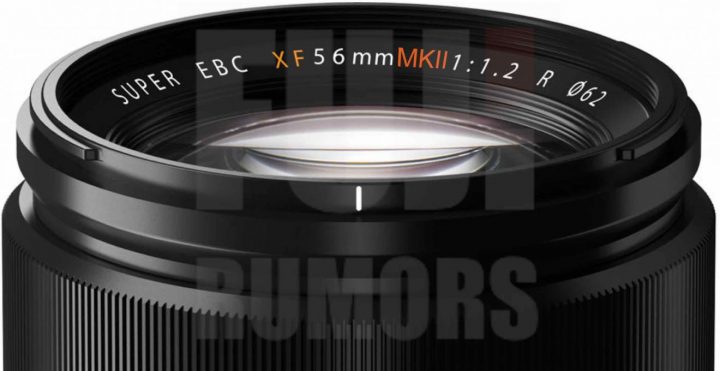
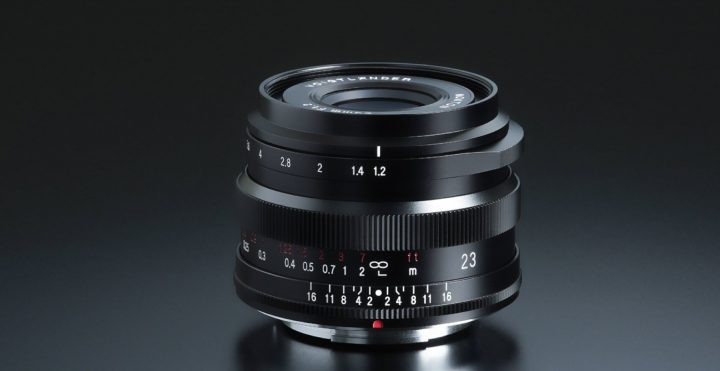
What I am referring to is a full announcement, hence with full specs and pre-orders. That’s not going to happen for the Fujinon XF56mm f/1.2 MKII.
We have seen in past X summits that Fujifilm has shown mock-ups of future lenses and even future cameras without actually fully announcing them. So I don’t know if Fujifilm plans something like that also for the XF56mmF1.2 MKII. That would be atypical, as, looking at the past, Fujifilm usually does not tease MKII lenses, but I can’t rule out anything in this regard.
But hey, May 31 will be exciting also without the XF56/1.2MKII. So make sure to follow us on FujiRumors.
Fujifilm X Summit on May 31 – Full Live Coverage on FujiRumors
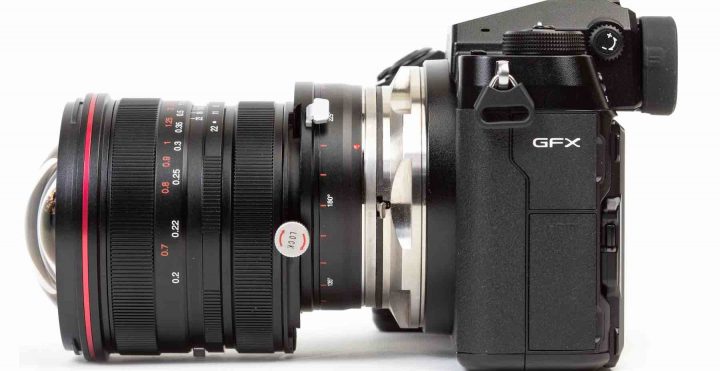
Back in 2020, Venus Optics announced the original Laowa 15mm f/4.5 Zero-D shift lens (blue ring version), which thanks to an adapter worked also on Fujfilm GFX with the ability to shift ± 8mm with no vignetting.
Now Venus Optics announced a new version, the Laowa 15mm f/4.5R Zero-D Shift (red ring version) with 14 aperture blades instead of the 5 aperture blades of its predecessor.
The good news: Laowa is now offering both the Laowa 15mm f/4.5 Shift lenses (the blue ring and the red ring versions) in native Fujifilm G mount, hence no more need to use any adapter.
But yeah, I can’t see the future. Nobody can. So Tony’s opinion is just as valid as mine. The future will tell.
Two System, Less Cameras and Lenses for APS-C due to limited R&D
Maybe I am not so much into other brands, but I don’t feel like Fujifilm is releasing less gear than other brands.
The real issue was more that so far not many third party brands released AF lenses for Fujifilm, but that has been solved in the meantime.
But in some way it is true. No GFX system could potentially mean more resources for X mount. But I think this is also why Fujifilm waited so long before offering a second sensor option. They did want to wait that their APS-C lineup is rich in lenses and once well covered, they can free up resources for other projects.
Lack of Fast Lenses
First off, let me say that there are many fast Fujinon XF lenses such as the XF200mmF2, XF8-16mmF2.8, XF50mmF1.0 as well as all the nice f/1.2 and f/1.4 primes.
But what about the f/1.8 zooms he’d wish for the X system? Well, that brings us to the next point.
High ISO
In the past, pushing your digital cameras to high ISO was something we absolutely wanted to avoid, as the performance was so bad. To avoid to go too high with ISO, we did indeed need fast glass for low light photography.
But that was the past. Today, ISO performance on digital cameras is vastly improved, which means you don’t need to try to desperately avoid high ISO with super fast and expensive glass. Nope, you can also push ISO up much higher than you ever could in the past.
What this means is that you can put smaller, lighter and more affordable lenses on your camera, as you can compensate the slower aperture with a higher ISO value.
Down below I will share a video of an extreme low light recovery I made of my wife overlooking the hills of Ronda in Andalusia, Spain (we made our honeymoon there). She basically went from almost invisible black to nicely visible in clean colors (thank you X-Trans for that high color fidelity) and in my eyes also very contained levels of noise, which make the image pleasing and usable.
But what about Bokeh? Let’s talk about it.
Bokeh
Not enough background blur? Well, this one is easy to answer. I’ll just share an image down below. And it’s not even the fastest lens Fujifilm has to offer (you can get even more radical with this one).
Autofocus (and Computational Photography)
True, Sony and Canon have better autofocus. But the point with autofocus is, that once it is near perfect, there is not much to improve anymore. Fujifilm just needs to catch up with Sony and Canon, and then the “autofocus war” will be basically over, since there will be little room for further enhancements.
Where there is much more room for improvement, is computational photography. And this is an area where smaller sensors simply are superior to bigger sensors. In fact, if done wisely, it could be even lead to a Renaissance of the M43 system (as the Panasonic GH6 shows with its terrific high res handheld mode). And certainly APS-C has a potential advantage here over full frame or medium format.