Skip to content

Fujifilm 2017 Rewound: Top Highlights Month by Month

Fujifilm 2017 Rewinded

2017 was another exciting Fuji X year, and in order to cover it properly, I have shared almost 1,000 blog posts.

A lot of things happened, and maybe some of you might have missed something. So I have checked back all articles and selected some highlights for you. No FujiRumors rumors are included in this list.

It was not easy to pick out a few highlights… but below you can find the list month by month. Let us know what you consider the highlight of 2017.

** CLICK HERE to Read the Rest of the Article **

Fujifilm Vision 2019: “We Work Toward Capturing No.1 Market Share in Premium Mirrorless Market” (Medium-Term Plan VISION2019)

Wow… now that’s an ambitious goal.

Fujifilm just published their new medium-term management plan, called VISION2019, covering a three year period from the fiscal year ending March 2018 (FY2018/3) to the fiscal year ending March 2020 (FY2020/3.).

And regarding their imaging division they write:

  • In digital cameras, work toward capturing No.1 market share in the premium mirrorless camera market, promoting the X Series that continues to evolve with outstanding image quality, fast speed and mobility, alongside the medium-format GFX Series that uses a large sensor, 1.7 times bigger than that of full-frame cameras, to pursue the pinnacle of image quality.
  • Reinforce the lineup of its highly reputable interchangeable lenses to continue to achieve increased revenues and profits in the mirrorless system business as a whole.
  • Broaden the lens business by expanding the lineup of 4K broadcast lenses, launched ahead of the rest of the world, as well as the lineup of lenses for the fast-growing new video production market, including online video.
  • With regard to the “INSTAX” instant camera and film, expand the sales of existing products and promote its square-format products for greater proliferation. Expand printing service solutions with added convenience, e.g. incorporating AI, to boost printing demand from smartphones to maintain the upward trend in profits.
  • FY2020/3 targets: 380 billion yen in revenues, 45 billion yen in operating income and 11.8% in operating income ratio

The competition is obviously very strong, especially from Sony, who are dominating, as we can also see from the AmazonUS mirrorless bestseller charts. But it’s good to see Fujifilm so confident about their present and future products, such as the sensor stabilizied Fujifilm X-T2S and of course the Fujifilm GFX 100S.

And you know what would sound really PREMIUM, too? That XF33mmF1.0!

Now, I want you to get quickly to the comments down below, so I won’t copy & paste the entire long press release here on FujiRumors. But if you want to read more, also about the medical, documents & co solutions and goals, check out the Fujifilm page here.

Fujinon XF50mmF2 Admiringlight Review: “It Continues Fuji’s Excellent Reputation for Creating Quality Optics.” + Kevin Mullins’ Suprising Gem


FUJINON XF 50mm F2 WR Reviews

Earlier Articles shared today on FujiRumors:

  • Sony Officially Shows the New 100 Megapixel BSI Medium Format Sensor for Fujifilm GFX 100s – More here
  • Fujifilm GFX: See FLM L-Bracket Mounted on GFX (+ 2 More GFX L-Brackets), Touchy Feely, Experience in Mongolia – More here

Kevin Mullins: Fujifilm 50mm F2 ~ A Surprising Gem at f16.click: “This is where the little lens has taken me surprise; I’m using it all the time when shooting weddings and guess what? I’m really enjoying using it. The 50mm F2 is a brilliantly built, epically quick and phenomenally fast lens. I love it.”

Admiringlight: Fujifilm Fujinon XF 50mm f/2 R WR Review at admiringlight: “The 50mm f/2 provides great value and high-end imaging in a small package, and continues Fuji’s excellent reputation for creating quality optics.

Pros

  • Very solidly constructed and compact lens
  • Wonderful haptics on the aperture and focus rings
  • Reasonably fast and very accurate autofocus
  • Quite sharp at any aperture, even into the image corners
  • Very pleasing bokeh
  • Good control of lateral chromatic aberration, flare and vignetting
  • Affordable

Cons

  • Longitudinal CA can cause a magenta or green fringe in front of or behind the focus point
  • A touch of pincushion distortion

Fujifilm XF50mm: USA BHphoto, Adorama, AmazonUS EU: AmazonDE, AmazonUK, WexUK, ParkCamerasUK, PCHstore AUS: CameraPro

Merry Christmas to All FujiRumors Readers!

Dear FujiRumors Friends,

Warm wishes to all of you for a Merry Christmas and a wonderful holiday season. Once again, I want to say thank you for being here, for reading, commenting, sharing, and for making FujiRumors what it is today. This community exists because of your passion for photography and for Fujifilm.

No matter if you’re out shooting with an X-series camera, a GFX, or simply enjoying photography in any form, I hope these days give you time and inspiration to focus on what truly counts: the people we love and the moments we share with them.

I’m incredibly grateful for all of you. Truly ❤️

And if during the holidays you feel like doing something meaningful with a few spare euros or dollars — even just 1, 2, or 5 — you can consider supporting KNGO in Cambodia, an NGO that FujiRumors has proudly supported for many years.

To give you an idea of the impact:

  • 20 dollars can provide one student with school supplies for an entire year

  • 50 dollars cover all expenses for one student for six months

  • 100 dollars fund a full one-year scholarship for one student

Thanks to your generosity, many children have already gained access to free education. If you feel like helping again, your support truly makes a difference.

Happy Holidays to you and your families.

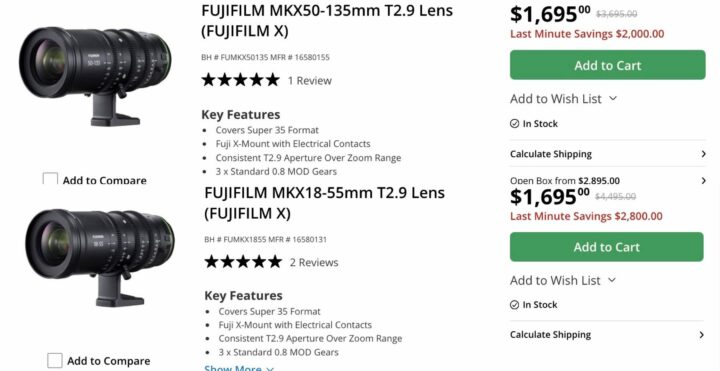
Fujifilm MKX Lenses Now up to $2,800 Off

The Fujinon MKX cine lenses are now up to $2,800 off at BHphoto.

I don’t see these deals listed on the official Fujifilm rebate page, so, like a few more offers below, these seem to be BHphoto deals and I don’t know how long they will last.

Unofficial XF Lens Deals – unknown ending date

Official XF Lens Deals – end January 18

** CLICK HERE to Read the Rest of the Article **

Fujifilm Mysteriously Removes GF32-64mmF4 Firmware From Its Website – UPDATED

UPDATE: Fujifilm put the firmware back online after our article. The issue (probably): Fujifilm seems to have made some re-designs on the website, and maybe they just forgot to upload the GF32-64mm page again.

Fujifilm has so far released two firmware updates for the (currently heavily discounted) Fujinon GF32-64mmF4.

  • ver.1.20 – improved exposure tracking in video and reduced focusing motor noise
  • ver.1.10 –  phase detection support for GFX100

However, for reasons currently unknown, Fujifilm has removed the GF32-64mmF4 firmware from its official website. If you try to access the dedicated firmware page, you’re now greeted with a 404 – Page Not Found error here – cached page here.

At this point, it’s unclear why Fujifilm decided to pull the firmware. Personally, I’m running firmware version 1.20 on my own GF32-64mmF4, and everything works flawlessly. In fact, I really appreciate the faster and quieter autofocus performance it delivers.

That said, firmware doesn’t just disappear from an official support page without a reason. Even if version 1.20 seems perfectly fine in day-to-day use, Fujifilm’s decision to remove it suggests that there may be an underlying issue we’re not aware of yet.

For this reason, I strongly advise fellow GFX shooters not to install firmware version 1.20 if someone happens to share the file privately. Until Fujifilm clarifies the situation or republishes the firmware, it’s better to stay on the safe side.

* freebies at BHphoto include a free CFexpress Type B Card and a camera bag

Unofficial XF Lens Deals – unknown ending date

Official XF Lens Deals – end January 18

Official X Camera Deals – end January 18

Fujifilm Celebrates Classic Chrome With New Videos and Recipes by X Photographers

Fujifilm has started publishing promo videos about some of their film simulations. You can see both videos in this article.

  • Classic Chrome – Relive a Golden Age
  • Provia – Vivid Memories

Also, a couple of Fujifilm X Photographers have also shared their Classic Chrome based film simulation recipes. You can take a look at their videos below, and if you particularly like a specific look, you will find the settings inside those videois.

A few weeks ago Fujifilm has also published their first official Film Simulation recipe called FRGMT BW, and it is baked into the menu system of the new Fujifilm GFX100RF Fragment Edition.

Classic Chrome Recipes

** CLICK HERE to Read the Rest of the Article **

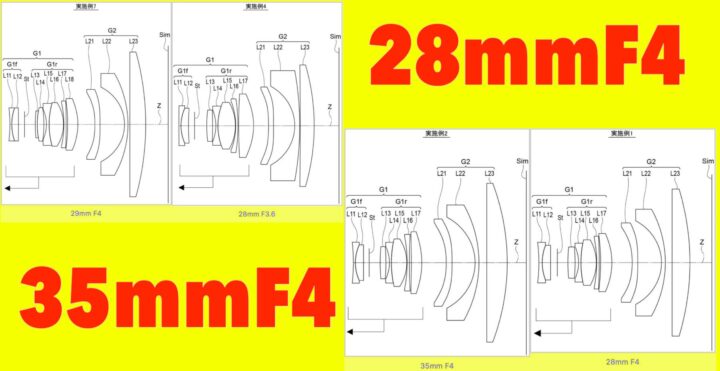
Fujinon 35mm F4 and 28mm F4 Patents Spotted

Two patents showing a Fujinon 35mmF4 and 28mmF4 lens for a format “larger than full frame” have now surfaced and reported about at the Japanese website Asobinet.

These are patents very likely for a fixed lens GFX camera.

We remind you the Fujifilm GFX100RF features a 35mmF4 lens. Maybe you’d have prefered a 28mm lens?

** CLICK HERE to Read the Rest of the Article **

Sony DGO vs DCG Sensor – The Pros and Cons – And What Would You Like on Fujifilm’s 6th Generation Cameras? – VOTE

DGO vs DCG

After our in-depth article on Sony’s new DGO sensor, other websites have finally started to pick up the topic.

But their coverage is still incomplete — missing key details (and some serious drawbacks) that photographers absolutely need to understand in order to use this new technology to its full potential.

Why these points are being glossed over is unclear, especially since they’re crucial for Sony A7V users who could unknowingly lose up to 1 stop of dynamic range compared to the older A7IV if they’re not careful.

So let’s break down the pros and cons in a quick overview. And if you haven’t yet, give our main article a read — it clearly explains the difference between DGO (Dual Gain Output) and DCG (Dual Conversion Gain), which is essential to understanding this debate.

DGO advanatges

  • Excellent dynamic range at low ISO

DGO limitations/downsides

  • No DR benefit above ISO 400/500
  • No DR benefit at all with electronic shutter
  • Up to 1.5 stops DR loss with e-shutter compared to mechanical shutter
  • the old Sony A7IV gives you about 1 stop more dynamic range than the brand new Sony A7V between ISO400-800 if you use electronic shutter, because on the A7V dual gain kicks in only at ISO1000 (vs ISO400 on A7IV

So, just be aware that there is no DR benefit when using electronic shutter and if you use ES in values between ISO400 and ISO800, you actually lose 1 stop of dynamic range over the older Sony A7IV

The Fujifilm Sensor Future

Sony is not keeping this technology to themselves.

In fact, the first mainstream hybrid camera to use a Sony DGO sensor wasn’t a Sony at all — it was the Panasonic S1II.

And since that sensor is already available on the market, I see no reason why Fujifilm couldn’t buy and use it as well.

So the real question becomes: what would you prefer for Fujifilm’s 6th-generation cameras — a DGO or a DCG sensor?

If you rely heavily on the electronic shutter, DGO might actually work against you. In the best case you get no benefit at all, and in the worst case you could lose up to 1 stop of dynamic range at certain ISO values.

But considering that high-end Fujifilm APS-C bodies already reach (for now) 15 fps with the mechanical shutter (compared to Sony’s 10 fps), the need for electronic shutter bursts is far lower on Fujifilm cameras anyway.

Personally, I’d be happy with either. I’m already “cheating” dynamic range via DR200/400, so both systems work for me. But if I had to choose, I’d take DGO if that still gives me access to DR200/400 — especially on GFX, where it could allow even higher pixel densities and higher base dynamic range, turning it into the ultimate high-resolution / high-DR platform.

My prediction?

I would not be surprised if DGO would soon become the industry standard. Nikon, OM System, Canon, Fujifilm — everyone will adopt it sooner or later.

But enough from me — let me know what you prefer by voting in the poll below.

I want Fujifilm's 6th generation GFX cameras to have a...

View Results

Loading ... Loading ...

I want Fujifilm's 6th generation APS-C cameras to have a...

View Results

Loading ... Loading ...

How Sony Is Rewriting Dynamic Range Sensor Performance (DGO vs DCG) — And the Hidden Drawbacks You Need to Know

Dual Conversion Gain (DCG) – The “Old” Tech

First things first: what exactly is Dual Conversion Gain?
Modern camera sensors — Fujifilm included — operate in two modes:

  • Low conversion gain: used at lower ISO values
  • High conversion gain: activated automatically at higher ISO values (for example, ISO 500 on the GFX100 II)

Let’s look at the Fujifilm GFX100 II dynamic range data using Photons to Photos data:

  • ISO 400 → 10.49 stops DR
  • ISO 500 → 10.91 stops DR
  • ISO 640 → 10.62 stops DR

Why does dynamic range increase at ISO 500 and ISO 640 compared to ISO 400?

Because that’s the point where the camera switches into high-gain mode, which reduces read noise and produces a DR “bump.”

For years, this dual conversion gain jump was the key method to maximize sensor performance.

But that changed—recently, and dramatically—with the launch of the Panasonic S1II first, and now also with the Sony A7V.

Dual Gain Output (DGO) – The New Tech

With the Panasonic S1 II (Sony-made, partially stacked sensor) and now the Sony A7 V, something unusual appeared in the data:

** CLICK HERE to Read the Rest of the Article **