It’s the night when ghosts rise from their crypts — and it reminded me that Fujifilm, too, has (or had?) a rather unnatural power: the power to bring its cameras back from the dead with a little bit of firmware Kaizen magic.
Cameras that refused to die.
Or better yet: cameras that Fujifilm simply did not allow to die — resurrected again and again through firmware updates that breathed new life into them.
Scary times in which those who wrote excellent Fujifilm camera manuals were doomed to rewrite them over and over again — slowly driven to madness by Fujifilm’s relentless Kaizen spirit, as they struggled to keep up with all the new features added to cameras that refused to stay dead.
So let’s talk about those times.
And let’s talk about where we are now and what has changed (if anything).
We were going on a 4-day trip with my classmates to Siena.
And I remember how I cherished those 27 shots — how intentional I tried to make every single one of them. Every frame mattered so much to me.
The photos might have been flawed — soft, overexposed, touched by grain and blur. But the moments were flawless. I waited for them, guarded each frame, and only pressed the shutter when I felt that it truly mattered.
But somehow all of that went lost with the arrival of digital.
That sense of loss — of meaning, of connection — is exactly what YouTuber Gerald explores in his video “What We Lost When Cameras Got Better”. He looks back at what we unknowingly traded away when photography became effortless, and how we might get those things back.
We thought we were upgrading to digital.
But we weren’t — we were trading.
And this is what we lost in the exchange, according to Gerald.
Intentionality –
Film forced us to think before shooting because every frame was limited and costly.
Digital made shooting cheap and endless, which made each photo mean less.
Presence –
With film, you stayed in the moment.
With digital, we’re constantly checking screens, pulled out of the experience.
Anticipation –
Waiting to see developed photos made us value them more.
Instant previews make us forget instantly — memories don’t have time to form.
Imperfection –
Film had character: grain, light leaks, and “happy accidents.”
Digital and AI perfection removed uniqueness; everything looks the same.
Mindfulness –
Shooting film is a tactile, focused ritual.
You set ISO once, advance manually, and truly participate in the process.
Digital gives results; film teaches discipline.
Conclusion
Technology didn’t just upgrade photography — it also caused a trade-off.
We gained convenience but lost meaning.
Unlimited shots led to unlimited forgetting, while limitations gave us value.
How to Get It Back
You don’t need to abandon digital. Instead, adopt the film mindset.
By slowing down and paying attention, you’ll remember your photos — and the moments — again.
So, in less than 1 month, the Fujifilm X-E5 has already surpassed legends like the Fujifilm X-T4 and caught up with one of Fujifilm’s most sold cameras ever, the Fujifilm X-T2. And right now it is just 2% points away from catching up with the Fujifilm X-T3 and X100VI.
If we were to group it in lines, these are the results.
X-T* = 32.21%
X100* = 15.20%
X-E* = 14.61%
X-H* = 9.98%
X-Pro* = 8.56%
X-T** = 8.41%
X-S** = 4.18%
X-M* = 2.25%
X70 / XF10 = 1.24%
X10/X20/X30 = 1.18%
X half = 0.64%
X-A* = 0.56%
Other = 0.51%
X-T100/200 = 0.47%
The Fujifilm X-E5 has pushed the X line close to the X100 line on the 3rd spot of the most owned Fujifilm camera lines by FR-readers.
Is this a success?
That’s too early to say. But it is a solid start, actually the best start of any X-E camera so far (and by far). And this makes me confident in the future of this camera line.
Yes, also the Fujifilm X-T50 is a “new line”, because as we told you in this rumor, it does not belong to the X-T10, X-T20, X-T30 line since Fujifilm will launch a dedicated successor for that line (X-T40/X-T30III) in 2025.
In short: Fujifilm has axed more lines than it has created new ones.
With all that said, I think launching the Fujifilm X-T40/X-T30III makes totally sense.
Why?
Well, because Fujifilm’s entry level line has basically been axed (except X-M line) and their other lower-end to mid-range models got an overall specs upgrade with a consequantial significant price increase (X-E5 and X-T50).
At this point in time, Fujifilm has no true entry level camera with viewfinder and that’s a problem if you ask me.
But how could a Fujifilm X-T30III/X-T40 look like?
Speculations (NOT RUMOR)
my realistic scenario: X-T30 II body with 5th generation processor and latest firmware
my hope scenario: X-T30 II body but with X-T100 alike unique screen mechanism – we reported here
my dream scenario: X-T50 body with 4th generation 26MP sensor
Since I think that price matters when it comes to the Fujifilm X-T40 or X-T30 III, I believe they’ll go for the first scenario I mentioned above.
But feel free to let us know in the comments what you think about all of this.
In that article I said that I personally would be happy to see an X half alike winding lever also on the Fujifilm X-Pro4.
Of course this was a very divisive opinion and I thought let’s vote on it.
And speaking of X-Pro4, after the survey I will share a few FR-readers wishlists and a video about it.
And if you think my thumb-winder idea for X-Pro4 is controversial, then you better skip the video of Luca Petralia ;).
Loading ...
by Arbekowicz
For X-Pro3 successor: Blocking systems for all dials (especially the exposure one), a more usable hidden screen, a frame for 18mm in the OVF, and real coverage or framing (currently I think there’s a 10% gap), a better viewfinder for glasses holders (may they be prescription or solar) and a smart protection for the sensor when changing lenses, like the lock system in Mamiya’s twin lens.
by Nelson
Xpro4 – add 4-way control back to this camera (and to x100v ); vastly improve optical viewer magnification or remove entirely; reduce overall body size if possible.
And with all that gear also came plenty of rumors.
So let’s take a moment to look back and see how accurate we’ve been so far in 2025 thanks to our sources:
59 rumors shared so far in 2025
1 rumor still to be verified
56 correct rumors out of 57 verifiable rumors
1 wrong rumor
1 rumor not in ranking
98.25% correct rumors
What’s left in terms of rumors for 2025?
Well, not much actually. Which is why below I insert also rumors shared back in 2024 that still have to be verified, such as this X-Pro4 release info rumor and Fujifilm TX-3 rumors. All ranked by reliability.
Rumor Overview with Rating
HIGH RATING* * 75% to 99% correct
GFX Eterna full announcement in September (shared June 4)
Fujifilm Panoramic Digital Camera currently discussed by Fujifilm (not final decision yet) for release in 2028 (shared May 6, 2024)
NOTE: I know that this is highly trusted, so they are discussing it. I just don’t rank it higher because this would otherwise give the impression that FujiRumors said this camera will come for sure. And in any case it is still 4 years away, so plans can change.
Fujifilm TX-3 Digital Panoramic Camera: Fujifilm Debating Between Bayer or X-Trans Sensor (shared September 2, 2024)
nothing. I mean, it could be the longest list considering the number of fakes I got also in 2025. But we don’t like to bother our readers with fake stuff like others do.
But there are also other features, also firmware related, like the new analogue mode, which further show that Fujifilm is really going wild with ideas on the Fujifilm X Half.
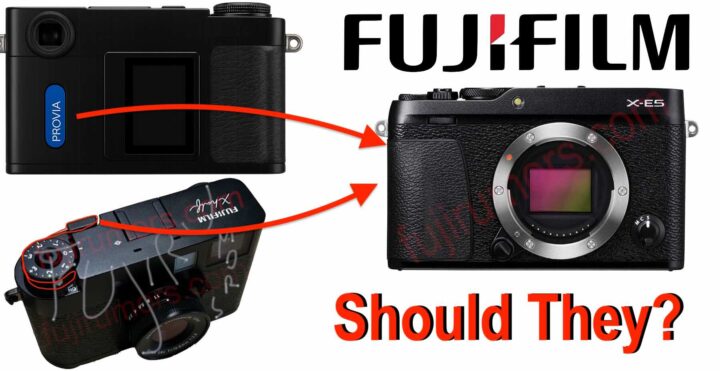
These features got me thinking: could any of these experimental touches make their way into Fujifilm’s higher-end X series cameras in the future? And more importantly—should they?
Let’s take the controversial LCD on the X-Pro3 as an example. Loved by some, loathed by others, that hidden screen was always a polarizing choice. But what if it was a small touchscreen instead? One that let you quickly swipe through film simulations or adjust key settings? Maybe that would breathe new life into the hidden LCD concept and win over more fans.
Personally, though, if I had to pick just one feature to bring to future X series cameras, it’d be the thumb winder.
Call me nostalgic—I won’t mind. The tactile joy of pulling a lever to take a shot again? That would be pure joy. And keep in mind, on the Fujifilm X Half the lever can serve several purposes. So you can see it as sort of a “function lever”.
If Fujifilm gave us a thumb winder with assignable functions on future cameras, that would be a nice touch.
But hey, that’s just my take.
What about you? Would you like to see any of these features on upcoming X series cameras? Cast your vote in the poll below and share your thoughts in the comments!
I don’t know if Fujifilm was “inspired” by this Canon camera, which first introduced the concept of a “Multi-function touch bar” on a mirrorless camera, but I guess we can say Fujifilm took that concept and enhanced it.
Here is why.
That little screen is an LCD touch screen. You can use to swipe and select your film simulation, but also to select/change menu settings. I don’t know if you can do even more with it, like zooming into an image or other things.
And it’s different to the little screen we find on the Fujifilm X-Pro3, which also shows the film simulation, but it is not a touch screen and you can’t use it to swipe through film simulations or settings.
I look forward to see that little touch screen in action in just a few days.




 Loading ...