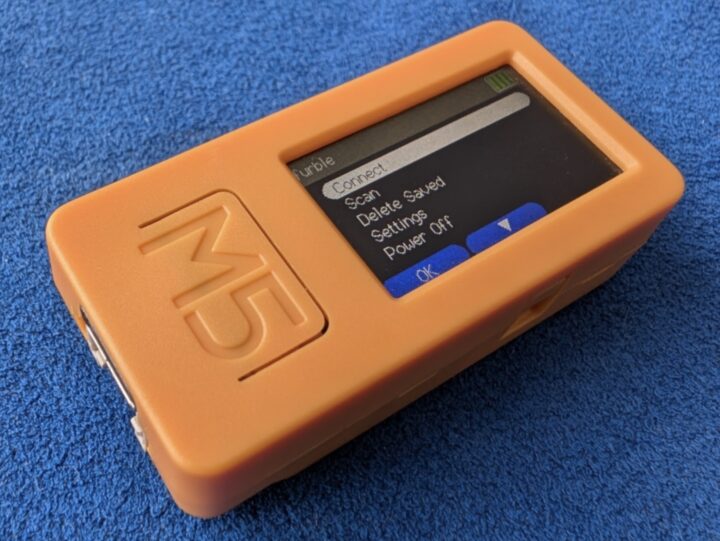
A couple of weeks ago, in our FR-reader wishlist roundup, FR-reader Keith wished for the following: a wireless remote shutter release for a Fuji GFX100 II, that does not require a transmitter and cable connection, and does not require a phone, like Canon is offering with the Canon BR-E1.
So, first you have to get the M5Stack, which is available globally at Amazon. There is also a newer version of the M5Stack, which you still don’t find everywhere, but it is listed also at some Amazon branches such as Amazon DE here and Amazon IT here, but you can also get it at shop.m5stack.
In any case, it will work with all of these M5Stack versions.
Once you have the device you load the firmware available at Github here on it. The firmware upload can now also be done via the installer web page here.
Done that, it will work as a bluetooth wireless remote shutter release.
You can see the list of Fujifilm cameras on which it has been tested to work at Github here.
On the project page, there is a section for ‘Installation’ (see here) which has a link to the recommended ‘Easy Web Install’ (see here).
We noticed that once again the growth for the imaging division was very strong.
And it was very strong despite Fujifilm having had major supply problems since at least 2+ more years.
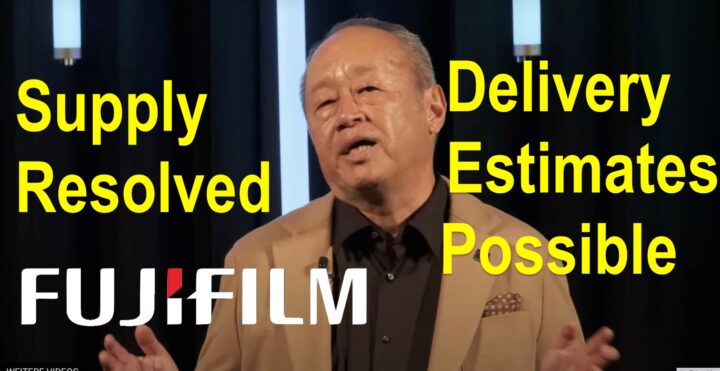
But things are slowly going better, at least according to the Fujifilm CEO, who in a Q&A for shareholders said this [google translated]:
The supply and demand issue that has been bothering us has been resolved, and we have increased production, so we are no longer in a situation where we don’t know when we will be able to get our hands on it.
We have now reached a point where we can roughly estimate when we will be able to deliver the product to our customers.
Let me say it is debatable whether the supply issue has been really “resolved”, considering that customers are still facing long wait times, like early X100VI buyers, who are still waiting months for their orders. But maybe there is a google translation issue with it. Maybe the CEO wanted to say they are “moving towards a solution”.
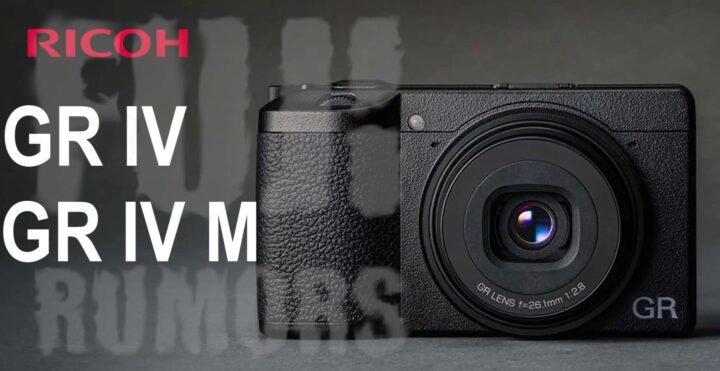
According to a source (thanks!!!), the popular Ricoh GRIII will get a successor pretty soon.
In fact, I have been told that the Ricoh GR IV (not to mistake with the Ricoh GR Digital IV) is set to be announced in the first quarter of 2025.
And possibly even more exciting than that, later on next year, Ricoh will also launch a monochrome version of it, which for now we will simply call the Ricoh GR IV m.
So again:
Ricoh GR IV in first quarter 2025
at some point in 2025 (after the GRIV), there will be also a monochrome Ricoh GR IV M.
Here on FujiRumors we have been long asking for a monochrome X100 camera (or X-Pro). Sadly Fujifilm has not delivered so far, but I am happy to see other brands giving more options in this regard, so we do not have to go for the super expensive Leica offering.
One more reason for Fujifilm not only to work hard to ship as many X100VI’s as possible before the new Ricoh GRIV drops, but also to finally consider to give us a monochrome camera before other brands eat up too much of that market niche.
Koji Matsumoto, the president of Fujifilm Imaging, age an interview in Japanese to phileweb here.
In summary:
X100VI, X-T50 and GFX100S II sales are strong
The balance between supply and demand has collapsed, but it has recovered this year
X100VI and others are still in a difficult situation “but we are gradually loosening back orders”
Fujifilm’s CEO notes that smartphone ease-of-use has increased global demand for instant and mirrorless cameras [admin note: I guess he means that more people take pictures now than ever and now many smartphone users aspire to take even better pictures using a proper camera]
the fact that demand has increased dramatically globally is the root of the problem of product supply. The supply is not keeping up. Fujifilm apologizes for the inconvenience
Some asked us how much gear Fujifilm releases every year.
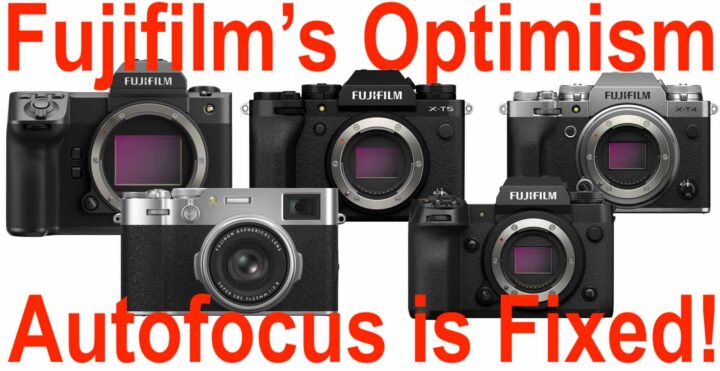
So we decided to check back the last 3 years (2024 included, since there won’t be any more announcements) to see what the current pace at Fujifilm is. Below are the results.
If Fujifilm maintains the pace it set in 2024, there could be room for one or maybe even two more camera releases in 2025, considering that the 1″ sensor camera might not be counted in the lineup we discussed earlier, which focused solely on APS-C and medium format models.
LENSES in 2025:
Fujifilm has quite consistently released around four lenses each year, combining both X and GFX series models.
So far I have no rumors about future lenses, which means you have four slots you can fill in with your wishes. :)
If anyone out there can maybe give us a hint on future X and GF lenses, feel free to reach out to FujiRumors. Your help would be greatly appreciated.
Overall, 2025 remains a significant mystery, but I’m hopeful that our trusted sources (and maybe some new ones) will be able to shed light on some of the unknowns and provide insights that will make us even more excited for what’s to come.
Until then, keep shooting, keep enjoying life… and every now and then, keep checking in on FujiRumors ;).
The French website Phototrend had the opportunity to interview Franck Bernard, Director of the imaging division at Fujifilm France. You can read the full interview here and the summary below.
Fujifilm is doing very well, both X and GFX series
the only things Fujifilm suffers from a little is the availability of products
Based on GFK data (largest German market research company), outside of Full Frame, Fujifilm is market leader with 40% market share thanks to X and GFX system
X-M5: there was still demand for cameras in this price segment especially among young people
AI will only bring benefits to the photographic business in general, and especially on the print side. Facilitate the production of a photo album, with a minimum of clicks: AI will be able to help us a lot
XF16-55mmF2.8 II completely redesigned lens
next generation linear motors used on XF16-55mmF2.8 II are smaller than the ones in the older generation
improvements in ED, Super ED and aspherical lenses has also allowed to reduce weight and gain compactness
no OIS because most Fujifilm cameras now have IBIS
X-M5 comes in brown package to reduce Co² emissions (reduce colors, packaging, carton consumption and, if possible, the number of cables)
film simulation contribute the the “return to film” trend. But while there is a notable resurgence of interest in film photography, especially among younger people, its impact should be viewed with caution, as the market remains limited to specific products like disposable cameras and film
Fujifilm has no new film camera on the agenda
success of X100VI was unimaginable. The X100VI is an iconic product
X100VI production has been increased, but supply is complex and deliveries are not made overnight
X100VI is not cannibalizing sales of other Fujifilm cameras
I don’t know if the GFK data is for France or Europe only, or if it is about worldwide data. But 40% market share outside of Full Frame might not be a horrible position to be in.
Unfortunately, Fujifilm has been heavily impacted by shipping challenges. Even if I were to underestimate the numbers, it’s likely that if all the X100VI, X-T5, X-E4, and other cameras ordered had been shipped in a timely manner, Fujifilm’s market share outside of full-frame cameras could easily be 60% to 70%.
But it is what it is.
I get that Fujifilm can’t suddenly build four new factories just because they’ve become a trendy brand. There’s the risk that, once the trend fades, they’d be left with four underused factories, turning it into a poor investment.
So they have to increase the production with what they currently have available in terms of manufacturing power.
But then I don’t understand decisions like keeping the old XF16-55mmF2.8 still in production (according to reports at CineD) even though there is now the new XF16-55mmF2.8 II on the market.
Wouldn’t it be better to focus the limited production capacity on making more lenses of the new version? Or stop making the old XF16-55 and free up manufacturing power to make the one lens that has become almost impossible to find all over the world, the Fujinon XF27mmF2.8 R WR.
With a few more strategic decisions, I believe Fujifilm could improve the ongoing supply shortage situation.
one of the most popular XF lenses is the XF16-55mmF2.8
the entire X summit is recorded with the XF16-55mmF2.8 II
37% weight reduction (410g)
image quality has been enhanced (less chromatic aberration and purple fringing, minimized ring patterns in bokeh, enhanced minimum focus distance)
weather resistant and linear motor
aperture click switch for smoother video recording
future firmware will improve aperture smoothness for video on several models. X-M5 already has this smooth aperture in conjunction with the new XF16-55
precise assembly
red badged lenses to be manufactured also outside of Japan, but with identical quality
Availability and Price
X-M5: $799 body and $899 for the XC15-45 kit – coming mid November