Fellow FR-reader Sven is specialized in IR and Astro conversions, and he recently did a fullspectrum conversion on his Fujifilm X-H2.
Here some excerpts regarding the teardown:
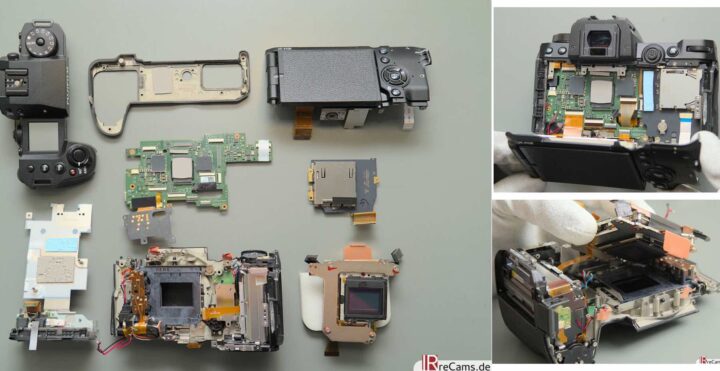
After a deep look under the hood, the design of this camera can be summarized as follows: Heat Management and Dissipation.
mainboard of the X-H2 reveals countless SMD components. With the amount of features packed into such a small camera, this is hardly surprising
the processor is covered with a heat conduction pad
The entire shutter mechanism is supported by small springs all around and has no direct contact with the body
this also explains why the camera’s shutter is relatively quiet and has this very special muted sound
The heat of the X-Trans V sensor is tapped directly on the back of the sensor via a delicate heat sink and conducted to a copper plate on the stainless steel chassis
As for the IR performance, they write:
Some modern sensors can show fine, mostly horizontal lines in the images. This is probably caused by PDAF pixels (“AF pixels”) on the sensor. These occur more often with strong IR filters and with very high-contrast processing. How does the X-H2 perform with an 830 nm infrared filter? With overly high-contrast processing, no lines or other artifacts are visible at 100% view (aside from noise, of course, induced by the high-contrast processing). The new sensor is a clear recommendation and can be used without restrictions.
As well as a firmware request:
Unfortunately, the X-H2 shares the same handicap as all X-Trans cameras. The manual white balance is always set without any problems, but the available range is not quite sufficient. […] Unfortunately, a warm magenta color cast remains in the camera and has to be corrected on the PC.
Fujifilm can actually do that, with their Bayer sensor cameras (X-A series and X-Txxx) it works without any problems
The X-H2 seems to work a bit better than the X-T3, but you can’t get rid of the color cast completely
In the unlikely event that a Fujifilm firmware designer reads this: Please expand the limits in both color axes in which manual white balance can be set. A little bit wider and the cameras internal white balance will work for infrared as well. Such a change can be distributed in a future firmware update in my eyes and should neither harm anyone nor cause too much work in programming.
Read the full article and see all the images at irrecams here.
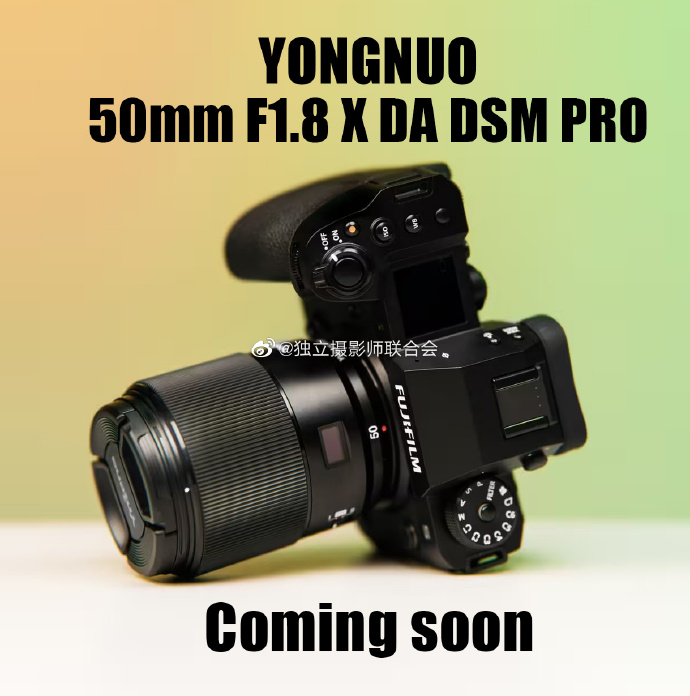
Now an image appeared on the Chinese social media Weibo (and spotted by the Japanese website Asobinet) showing the lens mounted on the Fujifilm X-H2S (you can see the image above).
Coming in June… with Aperture Ring?
If the google translation didn’t mess it up, I think Yongnuo said on their Weibo account that it will come in June.
Anyway, if they did add the aperture ring, than that’s definitely a nice touch and I wish other lens manufacturers would have done the same when they adapted their Sony E mount glass to the X system.
The complete list of autofocus lenses Yongnuo is planing to launch is:
Yongnuo 11mm f/1.8
Yongnuo 23mm f/1.4
Yongnuo 33mm f/1.4
Yongnuo 50mm f/1.8
Yongnuo 56mm f/1.4
Some of these new Yongnuo lenses are going to have some stiff competition:
The goal of the survey was to find out how popular the newest 5th generation X series cameras have become among the FujiRumors community.
The results surprised. And not because the Fujifilm X-T5 sold well. That was to expect. But because despite being launched just a few months ago, the Fujifilm X-T5 is already the most owned Fujifilm X series camera among this community.
And more impressively: this is the first time that any Fujifilm X-T camera has some serious internal competition in the higher end Fujifilm segment thanks to the Fujifilm X-H2. But despite this stiff internal competition, the X-T5 made it to the top as your most owned camera in just a few months.
Speaking of X-H2, it is 7th in the ranking, showing the huge popularity of the 40MP X-Trans V sensor.
In the battle X-H2S and X-H2, the X-H2S wins and grabs the 6th spot, but with only a few votes of advantage.
The first non-XT camera in the ranking is the Fujifilm X100V on the 5th spot, slightly ahead of the X-H2S. The next rangefinder camera is the X-Pro2 on the 9th spot
NOTE: The popularity of camera (lines) on FujiRumors is not indicative for the overall popularity on the worldwide market.
Top 10 Cameras
X-T5
X-T3
X-T4
X-T2
X100V
X-H2S
X-H2
X-T1
X-Pro2
X-H1
Popularity of Camera Lines
X-T* line = 38%
X-H line = 14%
X100 line = 11%
X-E line = 11%
X-Pro line = 9%
X-T** line = 7%
X-S line = 4% (X-S20 missing from survey)
all other X series cameras Fujifilm ever made = 6%
And given all those major releases, I was wondering how successful they have been among the FujiRumors community.
That’s why today I will launch an updated survey where you can tell us which camera you own.
Let’s see if there was a breakthrough in terms of 5th generation gear here on FujiRumors or if many of you did not update to the latest and greatest and stick with their older gear.
Important Note: If you pre-ordered any of the gear listed below and just wait to get it shipped, you qualify as owner.
Fujifilm’s X-H2S product planers and Autofocus developers meet in the latest X-Lab episode to talk about the improvements Fujifilm made with firmware 3.00 on the X-H2S.
Now, it’s again available only in Japanese so we have to rely on the automatic YouTube translation tool, which is far from ideal.
But don’t worry, you don’t have to do that. I went through this at 6:30 AM while drinking my coffee and I will sum it up for you below.
But if any Japanese speaking reader would like suggest corrections/additions to my summary, feel free to do so by writing me at fujirumor@gmail.com or drop it down below in the comments.