Skip to content

Fujifilm’s Biggest Sales Hits & Misses Since 2017 on FujiRumors – Sales Ranking

I owe you an update.

When the X-E5 was launched I told you that preorders were higher than the ones of X-T5, second only to X100VI.

But I also said that we were still in a period in which orders could be canceled and cameras returned. So the true question is: did the X-E5 hold up to its spectacular pre-orders? Or did many cancel their order?

Well, here is the final data.

But I guess I need to give you context.

  • Timeframe: Initial two-week sales period post-announcement.
  • Accuracy: Final figures only (adjusted to exclude returns).
  • Starting Point: all camera announcements since January 2017

Positive Surprises

We can see the Fujifilm X-E5 did exceptionally well. It sold just one camera less than the X-T5 which puts on the third spot with a nice margin ahead of the X-T3.

The Fujifilm GFX100RF is another positive surprise, narrowly bypassing the previous GFX king, the Fujifilm GFX100S.

The Fujifilm X-M5 finally gave “entry level” a reason to exist, by selling very well compared to ever other X-A, X-M and X-T*** cameras Fujifilm launched in the past.

Negative Surprises

I am shocked to see the Fujifilm X-S20 so low in the ranking. It’s one of the best cameras Fujifilm ever launched. And overall the X-S line seems to struggle, given the poor Fujifilm X-S10 results, too. I guess this makes it officially one of the most underrated Fujifilm cameras ever.

Another shocker is the Fujifilm X-T200, which made zero sales here on FujiRumors.

Reality Check

Of course the ranking below is not representative for the entire market, since FujiRumors readers are generally more interested in higher end gear.

Let’s Rank It

  1. X100VI
  2. X-T5
  3. X-E5 – just one camera less sold than X-T5 and well ahead of X-T3
  4. X-T3
  5. X-T4
  6. X100V
  7. GFX100RF
  8. GFX100S
  9. X100F
  10. X-M5
  11. X-H2
    X-H2S
    X half
  12. X-T50
  13. GFX50R
  14. X-H1
  15. GFX100II
  16. X-Pro3
  17. GFX50S
  18. X-T30
  19. X-S20
  20. X-T30III
  21. GFX100
  22. X-E4
  23. GFX100SII
  24. X-T20
  25. GFX50SII
  26. X-S10
  27. X-E3
  28. X-T100
  29. X-A5
  30. X-T30II

— No sales

Fujifilm X-T6 Coming in September: Listed by Fujifilm Shop Vietnam — But the Listed Specs Are Concerning

We know the Fujifilm X-T6 is coming in Septmber 2026.

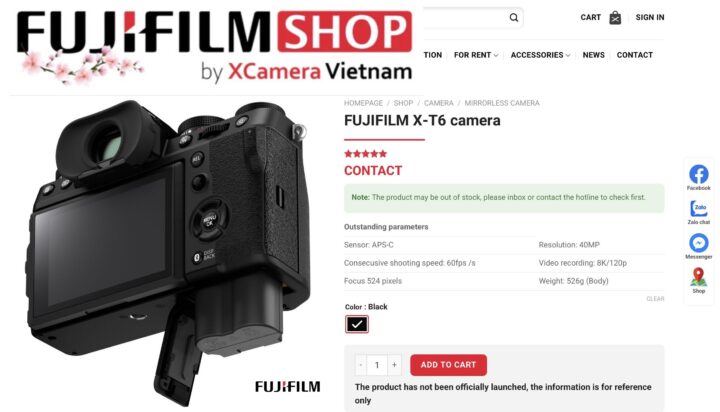
And apparently also the Fujifilm Shop by X Camera in Vietnam is getting ready for it, since they have already a dedicated page up here.

The shop writes: “The product has not been officially launched, the information is for reference only“.

So what is there “reference” they give us?

Well, a 40MP X-Trans VI sensor (which can make sense), an X Processor 6 (which makes sense) and they say it will feature a fully articulating LCD screen, since that’s a “superior design” over the 3-way tilt screen of the Fujifilm X-T5.

Now, attentive followers might have noticed some shots of me making wise use of the fully articulating screen of the X-T4, so much so that some wondered if now I have become a selfie screen lover.

But rest assured: the 3 way screen is all I want. Yes, there might be rare occasions in which the selfie screen turned out to be handy. But for 1 shot I found a good use for it, there were other 999 shots I just did not like it.

If the Fujifilm Shop Vietnam is right with their “reference“, and the X-T6 will come with a fully articulating screen, then this would either mean that:

  • Fujifilm has bend to the will of influencers who make a living out of filming themselves
  • the Fujifilm X-H line has been canceled and the X-T* line has to go back being the flagship

Now, we explained how the Fujifilm X-H line actually saved the Fujifilm X-T5. In short: after the shock of the horrible X-H sales, Fujifilm paused the X-H line and the X-T line had to become the new flagship, with all the problems that come with it: a bigger body, heavier and a fully articulating screen. All features that are not part of the original X-T DNA. Luckily the X-H2 came along, took over the flagship role again and the X-T5 could go back being what it was always meant to be: a wonderful camera mainly for stills photographers.

A guy on YouTube explained it perfectly in the video below ;).

So guys, I will make it now a top priority to try to find out which type of screen the Fujifilm X-T6 will use. If I have any update, I’ll share it here on FujiRumors. So definitely stay tuned.

X-T6 Specs as ber Fujifilm Shopt Vietnam

** CLICK HERE to Read the Rest of the Article **

Last Week of Fujifilm X and GFX Deals

The official Fujifilm X and GFX deals will end January 18. The only deal that will last until March 1 is the $200 rebate on X half.

Also, some of the unofficial Fujifilm deals at BHphoto have now expired (no more rebate on the XF90/2), but others are still running.

It is also unclear for how long Adorama will offer a free Fujifilm X half with X-T5 kit purchase.

Unofficial XF Lens Deals – unknown ending date – some expired already

Official XF Lens Deals – end January 18

Official X Camera Deals – end January 18

Official GFX Gear Deals – end January 18

* freebies at BHphoto include a free CFexpress Type B Card and a camera bag

How Many Cameras and Lenses Does Fujifilm Release Every Year? And What it Could Mean for 2026

2026 – A Big Fujifilm Year?

2026 could potentially be a huge year for Fujifilm. Fujifilm is going to start to upgrade their cameras to the 6th generation platform.

But how many cameras – and also lenses – can we expect to get in 2026?

Well, let’s take a quick look at how much gear Fujifilm announced in the past years.

Gear released in 2025 – 4 cameras and 3 lenses

Gear released in 2024 – 4 cameras and 4 lenses

Gear released in 2023 – 2 cameras and 4 lenses

Gear released in 2022 – 3 cameras and 4 lenses

Cameras in 2026

So, will there be more than just the two already rumored cameras in 2026?

If we look at Fujifilm’s history (not a rumor), the answer is very likely: yes.

As you can see above. Fujifilm rarely limits itself to just two camera announcements in a year—especially when a new generation of technology is involved. A platform transition usually triggers a cascade of releases, not just a single camera.

If 2026 is truly the beginning of the 6th-generation era, then what we already rumored could just be the tip of the iceberg.

And if Fujifilm maintains the pace it set in 2024 and 2025, there could be 2 more cameras in addition to the ones we already rumored.

It’s your time to guess what else could come ;).

Lenses in 2026

Fujifilm has quite consistently released around four lenses each year, combining both X and GFX series models, except for 2025, when we got 3 lenses.

So far I have no rumors about future lenses, which means you have three/four slots you can fill in with your wishes. :)

Let’s Make it an Awesome Rumor Year :)

If anyone out there can maybe give us a hint on future X and GF lenses, feel free to reach out to FujiRumors. Your help would be greatly appreciated.

Overall, 2026 remains a significant mystery, but I’m hopeful that our trusted sources (and maybe some new ones) will be able to shed light on some of the unknowns and provide insights that will make us even more excited for what’s to come.

Until then, keep shooting, keep enjoying life… and every now and then, keep checking in on FujiRumors ;).

Fujifilm X half Deal Extended – and More Fujifilm Rebates

Fujifilm has extended the $200 discount on Fujifilm X half until March 1.

Unofficial XF Lens Deals – unknown ending date

Official XF Lens Deals – end January 18

Official X Camera Deals – end January 18

Official GFX Gear Deals – end January 18

* freebies at BHphoto include a free CFexpress Type B Card and a camera bag

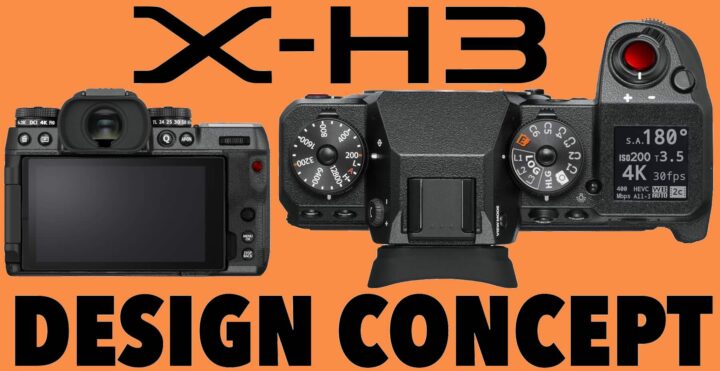
Fujifilm X-H3/S Design Concept: The Manual Dial Film Camera?

guest post by Francisco

Hey Patrick,

Fujis video capabilities are getting better and better. And since Fuji is the “manual-Dial brand”, I think Fuji should try a dedicated video-body with manual dials. We see the hybrid bodies getting the PASM Dial, which is fine, because it is usable for stills and videos. But a videocentric could be cool, and having no dials (like the Sony FX3, Nikon ZR or Canon C50) would just not be Fujis DNA.

Maybe there are videographers who like to adjust some settings on haptic dials. Something special, that only some nerds would appreciate. Not the ones that do professional video work, but the ones that like to get into video. I don’t have Photoshop anymore, but I wanted to create something to help visualize the Idea. I took the X-H1 as a starting point and adjusted the dials how i would imagine it. The X-H1 has a display, many manual dials and great ergonomics. Since this was only done with Paint and GIMP, it has his flaws and the Idea has some issues, but let me present it and tell you what I changed:

** CLICK HERE to Read the Rest of the Article **

Fujifilm 2026 Predictions by PetaPixel: All Reasonable… Except One!

PetaPixel shared their predictions for 2026. Regarding Fujifilm they say:

  • PetaPixel says that is not a bold prediction, because they strongly believe it is going to happen: X-TransVI and new processor on X-Pro4 in early 2026
  • Hope: keep X-Trans VI at 40MP but make it faster
  • Fujifilm has too many camera lines, which are more based on design changes rather than hardware changes, so they did hold off on X-Peo4 for so long because they need to make a big hardware change to it
  • Fujifilm could merge X-H2 and X-H2s into one line featuring a faster 40MP sensor
  • X-H3 will come after the X-Pro4
  • Fujifilm will make a digital panorama camera stacking 2 APS-C sensors next to each other. It would sell absolute crazy

Thoughts:

There is a lot of talk these days about the DGO sensors:

I think staying in the 40MP range but using a faster sensor readout is a prediction that makes sense. Although I have no info about X-Trans VI so I have no insight to confirm that or not.

The idea of merging the X-H/S lines into one single X-H3 is something we discussed here. There are Pros but also important Cons to consider with such a move, so make sure to read this article.

As far as X-Pro4 goes, the X-Pro is certainly the one camera most in need for a refresh, so it’s understandable that they think it will be next.

So far all PetaPixel predictions seem reasonable.

All but one!

PetaPixel predicts the Fujifilm TX-3 panorama camera in 2026. To my knowledge, if Fujifilm will make one, then it would come in 2028, because 2028 marks the 30th anniversary of the Fujifilm TX-1. But at this point I don’t know if Fujifilm has decided to really make it or not.

What we know for certain will come in 2026 are the Fujifilm X-T6 in the second half and a compact camera with 1″ sensor.

But let us know your predictions in the comments below.

Coca-Cola Risked Everything on a Cheap Fujifilm X-T3 — The “Disaster” Is Stunning

When Coca-Cola started scouting for a photographer for a major global campaign — one that required flying him around the world — they came across the name Frederik Trovatten, a guy with 18 years of digital-marketing experience.

Little did they know that Frederik would shoot the entire campaign using Fujifilm APS-C gear… which, as we all obviously “know,” has a 0.1% autofocus hit rate on well-lit static subjects and a dynamic range inferior to a cheap Amazon toy camera.

Too late. The flights were booked. The campaign was shot.

And the results, are exactly what we could expect. You can see them in the video above and on his website trovatten.com – Instagram: @trovatten

Advertising Campaign

  • Coca Cola flew him from Denmark to Mexico to do commercial 30 days of street photography
  • the project resulted in outdoor advertisements (exhibited at Oslo train station), television commercials, and even a painted mural
  • the campaign was also shortlisted at Cannes Lions Advertising Festival
  • the theme: tacos + Coca-Cola — in Mexico and anywhere else tacos exist
  • the creative concept: using a “Where’s Waldo?”-style approach, subtly placing Coca-Cola bottles/logos into vibrant, authentic street scenes around Mexico City’s taco stands instead of making the product the loud focal point

His behind-the-scenes video walks you through his days capturing the raw, energetic life of taco vendors, and it’s absolutely worth watching.

The Gear (Brace Yourself…)

For stills, he used the humble Fujifilm X-T3.

For video, the Fujifilm X-H2S.

Plus an Aputure MC Pro light and a Rode lavalier mic.

He says:

there’s no reason to get these expensive cameras when you can do big campaigns, commercials with cameras that cost $1,200

The results?
Massive prints that Coca-Cola proudly displays around.

Of course, according to countless forum experts — whose combined portfolio consists mostly of long, bitter comment histories — this shouldn’t be possible. Surely Coca-Cola would tear down every poster if they discovered they were shot on a “cheap” Fujifilm X-T3. Maybe even issue a global apology.

Or… maybe not.

Maybe Coca-Cola is actually quite proud this time — certainly more proud than of the 100% AI-generated Christmas ad they released this year. ;)

Fujifilm’s Sony-Level Autofocus Is Already Here — Hidden in Pre-Shot Mode, Waiting to Be Unlocked

Here We Are Again

When Fujifilm broke autofocus with last year’s firmware updates, Edvard was one of the YouTubers who delivered the most detailed, methodical, and technically grounded coverage of the issue.

Some people don’t like his tone. Others dislike the sarcasm or the way he presents his findings. That’s fine. None of that matters.

What matters is that his findings were legitimate.

And because they were legitimate, we shared several of his videos here on FujiRumors. And so we will do again today.

It’s a long video, which I will sum up below for you – a short version and a more detailed version.

Certain YouTubers Ignore Reality ;)

But before we get into the test results, I need to address something.

Sometimes, you hear accusations that “FujiRumors is a Fujifilm propaganda machine.”

I mention this now because in Edvard’s video, there’s a YouTuber who was “featured” and who, last year, claimed I deliberately don’t report on Fujifilm AF problems—that I only push propaganda.

There’s just one problem with that narrative.

Beyond the fact that when large YouTubers discredit FujiRumors it obviously hurts the blog’s reputation (you then see angry comments towards me), the real issue is something else:

At the time the YouTuber made those claims, I had already shared on FujiRumors his very own video in which he rants against Fujifilm autofocus—along with many other critical videos and several articles on the same topic.

That’s a textbook example of cognitive bias: ignoring observable facts, blanking out reality, and repeating a story that fits one’s pre-existing beliefs rather than what actually happened.

Facts, however, don’t care about narratives.
And FujiRumors will continue to report both the good and the bad—regardless of who finds that inconvenient.

FujiRumors exists for Fujifilm camera users, not for Fujifilm as a corporation. And that’s why, once again, we have to talk about autofocus.

The Findings in Short

NOTE: extensive summary of the 34+ minutes video below

Edvard noticed that in pre-shot mode – when you half press the shutter button and the camera starts saving images on the camera – the camera has a terrific autofocus.

Focus transitions from far to near (and back) are smooth and confident. Subject tracking is excellent. You can actually hear the lens making constant micro-adjustments, a clear sign that the camera is performing many AF calculations per second. There is no hesitation, no stalling halfway through a focus pull—just continuous, fluid, sold, sticky AF behavior.

In fact, it’s so smooth and fast that at minute 4:52 he literally says:

This is Sony-like autfocus, guys!

And that’s where the real problem emerges.

The moment you fully press the shutter, autofocus behavior changes. The camera appears to perform fewer AF calculations, the lens moves in larger steps, and the result is visible hunting—especially when transitioning between near and far subjects.

Interestingly, fast burst modes help. On his X-T3, shooting at 30fps with a 1/100s, Edvard reports “the smoothest tracking I have ever seen on a Fujifilm camera.”

Which leads to an unavoidable conclusion:

The autofocus performance is already there.

Fujifilm just needs to bring the Pre-Shot AF behavior to all shooting modes.

Conclusions

Rather than seeing Edvard’s video as an attack on Fujifilm, it should be seen as good news: the performance photographers are asking for already exists inside the camera. It just needs to be unlocked more consistently.

If Fujifilm manages to bring that Pre-Shot autofocus behavior to all shooting modes, then this discussion ends overnight—and Fujifilm autofocus suddenly becomes a non-issue for everyone.

And that’s exactly why it’s important to talk about these things.

The Test in Depth

** CLICK HERE to Read the Rest of the Article **

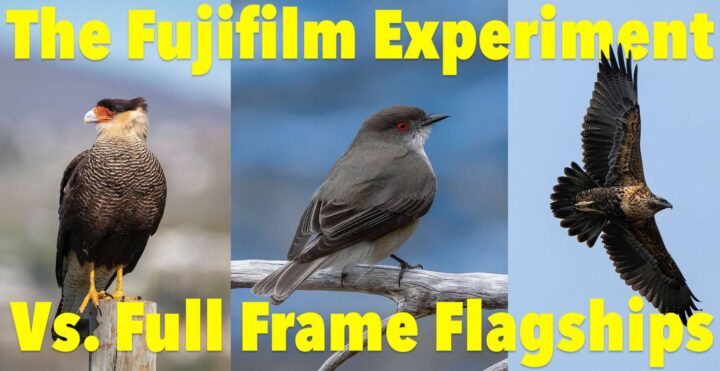
After 20 Years Shooting Full-Frame Flagships, He Took Fujifilm APS-C to Patagonia – And This is His Brutally Honest Review

Mattia Campos is shooting top-tier flagship cameras and lenses from all possible brands for sports and wildlife photography for 20 years now.

But for this trip to Patagonia he decided to try something completely new: the Fujifilm APS-C system.

So he got himself a Fujifilm X-H2S and XF500mmF5.6 and started his journey.

He documented his experience in a lengthy and brutally honest article, in which he shares truths that Full-Frame fanboys might not want to hear, along with fair critiques that Fujifilm should take seriously.

Was it a good experience?

In short: he was blown away by the Fujifilm APS-C system.

The best JPEG files and colors he has ever seen on any system (clearly superior even to Canon), ultra-flexible RAW files that did not make him miss his flagship full frame cameras and all this is a compact and affordable package you can only dream of in the Full Frame world.

In fact, he goes so far to say that the Fujifilm APS-C system could become a serious threat for all the high-end full frame competitors… if only one last thing gets fixed: autofocus!

To be clear: the autofocus is really good, but not yet on par with the top tier models from competitors. And he’ll explain what exactly did not work super-well in his article (and we sum up below for you).

I invite you to read the full article (written in Italian) and see all the images at the Italian website/forum juzaphoto.

The Article in Short

Preparing for Patagonia: Why He Chose Fujifilm

While planning his wildlife-focused trip to Patagonia, he spent months debating which gear would best meet his needs. In the end, he chose a setup he had never used before: the Fujifilm X-H2S paired with the XF500mmF5.6. Coming from years of shooting with flagship bodies and high-end lenses, the X-H2S felt like the natural choice within the Fujifilm ecosystem.

The trip included long and demanding hikes, but carrying the Fujifilm combo was never an issue. Its light weight and compact size—especially compared to full-frame flagship alternatives—made travel far easier.

First Impressions

His experience with Fujifilm was, in a word, fun.
He adapted quickly to the new system, though he did spend time learning menus and fine-tuning settings for different situations.

The X-H2S feels solid, handles beautifully, and offers a superb EVF. The XF500mmF5.6 delivers excellent image quality.

After 20 years photographing wildlife and sports with top-tier gear from multiple brands, he came to a surprising conclusion: for advanced and demanding enthusiasts, a high-quality Fujifilm APS-C system is the best pick in terms of overall balance of performance, weight, size, and price.

Why Fujifilm APS-C Makes Sense

With Fujifilm, you can build a truly capable system for less cost, size, and weight than equivalent full-frame kits. In many real-world situations, the image quality difference is not noticeable. Full-frame often means heavier, bulkier, more expensive gear, without a proportional gain in results.

Recently he has moved more toward shooting JPEGs for practical reasons: less time editing and less storage needed. Fujifilm’s color science is probably best on the market, followed by Olympus/OM System.

Image Quality: His Biggest Surprise

Throughout his Patagonia trip, he was genuinely impressed by the image quality.
X-H2S files are true-to-life, natural, neutral, and free of color casts, with exceptional color and detail. High ISO performance exceeded expectations, dynamic range is excellent, and the files are very flexible in post.

He has used many APS-C cameras from other brands, but none match the X-H2S in build quality, image quality, and lens ecosystem.

Compared to the Canon EOS R7, he found the X-H2S clearly superior in JPEGs, RAW files, high ISO, shadow recovery, lens selection, build quality, and EVF performance.

The XF500mmF5.6 is extremely sharp even wide open, with very pleasant bokeh.

Going Deeper into the Fujifilm System

His excellent experience with the X-H2S convinced him to dive deeper into the Fuji system, so he bought an X-S20 with the XF90mmF2. The X-H2S offers better autofocus thanks to its stacked sensor, but the X-S20 is still a remarkably capable little camera. Its joystick and lack of D-Pad annoyed him, but image quality—including dynamic range and ISO—may actually be slightly better.

Both cameras perform very well in difficult lighting while maintaining impeccable color and high detail.

The Weak Point: Autofocus

The only real downside he found is autofocus.
Switching from near to far subjects (or vice versa) can be slow, costing him a few shots every now and then—especially when photographing unpredictable wildlife. Continuous AF feels a bit rigid and less responsive in low light. Subject and eye detection work, but the menu system is unnecessarily complex.

Overall, the AF is actually good, but not at the same level of the top flagship systems he is used to.

If Fujifilm can overhaul autofocus responsiveness in the Fujifilm X-H2S II, it would spell serious trouble for all the competitors.

Why Fujifilm Could Become the First Choice

Given that Fujifilm APS-C gear costs significantly less, weighs significantly less, and still delivers image fantastic image quality, combined with industry-leading JPEGs, the Fujifilm system has all the potential to become a top choice for both amateurs and professionals alike, if they also catch up in terms of autofocus.

X Cameras

X Lenses