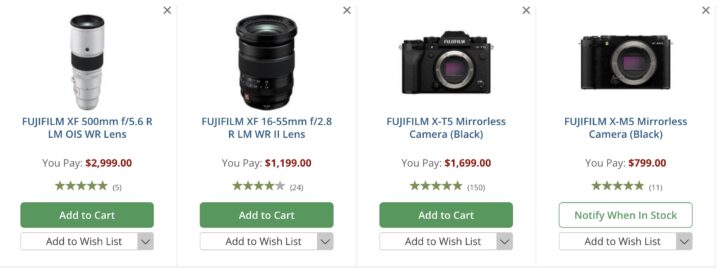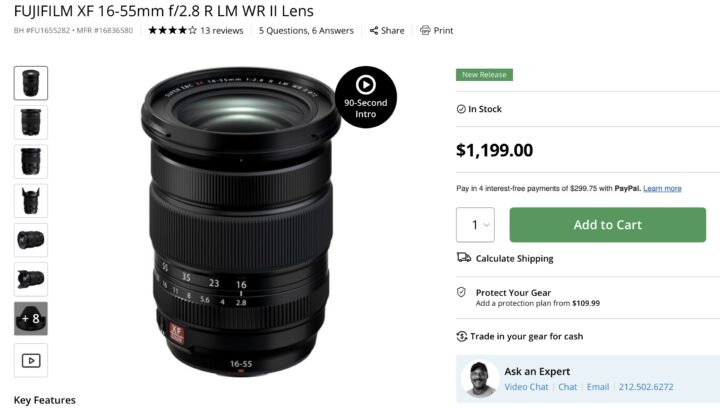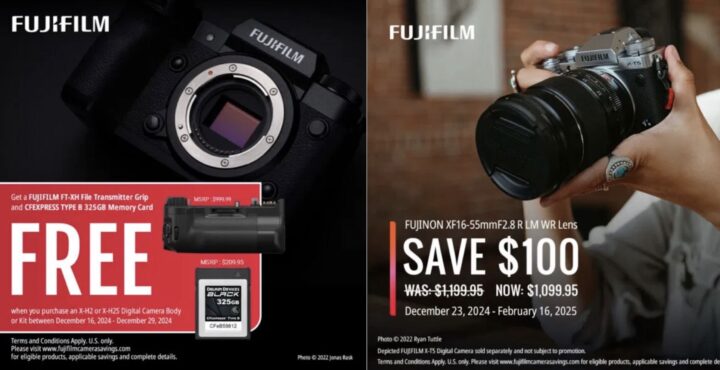




It seems that in terms of size the new Sigma 17-40mmF1.8 DC ART will sit somewhere in between the two Fujinon XF16-55mmF2.8 lenses.
As a reference: the Fujinon XF16-55mmF2.8 II weights 410 gram whereas the Sigma 17-40mmF1.8 weights 535 gram.
If the optical quality is very good (and we will find it out on June 17), then the Sigma 17-40mmF1.8 could be a game-changing lens for some fellow Fujifilm APS-C shooters.
We recently shared a comprehensive review/comparison of the Fujinon XF500mmF5.6 vs XF100-400mm for wildlife photography in this article called “Fujifilm Equipment for Wildlife Imaging: An Evolving and Compelling Choice for Serious Photography“.
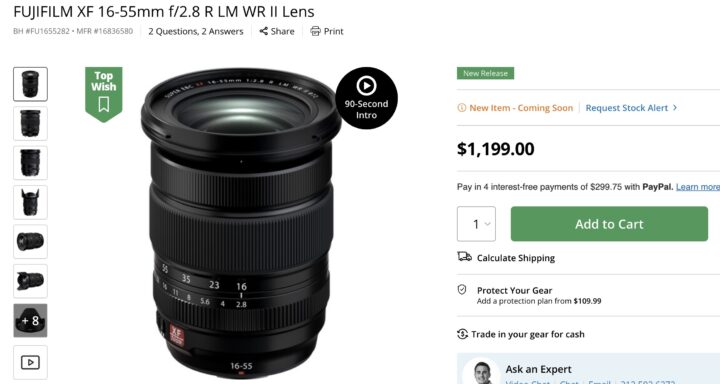
I got reports from readers of it being in stock also at Amazon here, but so far I can’t find them, so probably the lens was in stock just very shortly and just sold out quickly again.
This is inevitable since now we got the Fujinon XF16-55mmF2.8 R LM WR II, which is smaller, lighter and optically even a bit better. And it costs the same as the older version.
You can still find the XF16-55mmF2.8 MKI in stock in USA, Canada and Europe, but I guess these will be the last samples available and honestly quite hard to sell for Fujifilm if they do not decide to offer it with a substantial price drop.
At least for those looking to purchase a standard f/2.8 zoom lens.
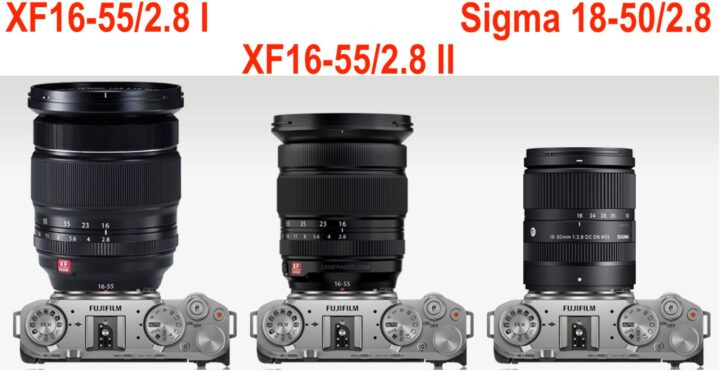
Because the two options we had, the Fujinon XF16-55mmF2.8 I and the Sigma 18-50mmF2.8 DC DN, were so different to each other that people did not have much to think about: if you want compactness, go for the Sigma. If you want a wider range and an aperture ring, go for the Fujinon.
But with the arrival of the new Fujinon XF16-55mmF2.8 II, decision making has become a bit more complicated.
As shown in the size comparisons above, the new Fujinon XF16-55mmF2.8 II falls between the older XF16-55 and the Sigma 18-50 in terms of size. So, if your primary reason for choosing the Sigma was compactness, the decision between the two lenses has now become a bit more challenging.
While the Sigma is still a bit smaller, the new Fujinon will give you a wider range (16-55 instead of 18-50), an aperture ring (which can be de-clicked), likely better weather sealing (as the one of the Sigma is rather basic), and something that is often overlooked: Fujifilm colors.
Look, I own third party autofocus and manual focus lenses. They are some fantastic offerings out there. But one of the main reasons I prefer my Fujinon’s, is that I get consistent Fujifilm colors. That’s for example also why I bought the Fujinon XF10-24mmF4. I did love my Samyang 12mmF2, but the colors just did not look like the ones I was used to when using my Fujinon glass.
However, there is still one huge argument for the Sigma 18-50mmF2.8: the price! If you look for best value for money, the Sigma might be the best option.
I guess the question these days for those, who already own the “old” XF16-55mmF2.8 is: should I upgrade the new XF16-55mmF2.8 II or stick with the old one?
In order to try to help you to find the right answer, I’ve searched for comparisons, but I was surprised to find that this particular comparison hasn’t been adequately addressed by reviewers at launch. If I missed them, please let me know in the comments, so I can add them to this article.
But now a new video has been released by FujiFanBoys that provides a quick comparison between the new Fujinon XF16-55mmF2.8 II and the previous XF16-55mmF2.8.
I will sum it up in bullet points for you, but if you want to see the sample images and get a few more details, check out the video above.
the new XF16-55mmF2.8 II is a bit sharper and has a bit more contrast
the new XF16-55mmF2.8 has a bit better bokeh
the new XF16-55mmF2.8 has a bit better autofocus
the new XF16-55mmF2.8 as virtually no focus breathing (the old one was good there too, but not as good as the new one)
the new XF16-55mmF2.8 is lighter and smaller
the new XF16-55mmF2.8 has a de-clickable aperture ring
So who is this lens for?
Well, if that’s your first XF16-55mmF2.8 lens, then go for the new one. It’s a lot lighter and smaller, it’s a bit better optically, and costs the same as the old one.
Things get more complicated if you already own the old XF16-55mmF2.8.
In this case, FujiFanBoys says that if you shoot mainly primes and already own the old XF16-55mmF2.8, then there is no need to upgrade. But if you rely a lot on the XF16-55 for your work, then size and weight alone are a good reason to upgrade.
And what was your decision? Feel free to let us know by voting the survey: